Spaceman by Pragmatic Play: Crash Game Mechanics, RTP, Cash-Out Features and Risk - A Full Research Review

Last updated: February 2026 · Reviewed by: the iGaming editorial team (method: sign-up, deposit, live play and a real cash-out are tested before any game or operator receives a score)

Quick summary: Spaceman is a crash game by Pragmatic Play, not an online slot. It runs at a stated 96.50% RTP, accepts stakes from $1 to $100, and can pay up to 5,000x the bet. No reels, no paylines, no bonus-buy feature. The only thing that decides your result is when you press Cash Out before the astronaut crashes. Below: the exact round flow, the maths behind the multiplier curve, how the 50% Cash Out works with real numbers, what demo mode can and cannot teach you, how to verify a casino before depositing, and which habits drain bankrolls fastest according to published research.
Spaceman by Pragmatic Play Crash Game

Quick Reference: Spaceman Technical Card

ParameterValue
DeveloperPragmatic Play
Game typeCrash game (multiplier-based), not a slot
Release dateFebruary-March 2022 (announced 22 February 2022; listed by most operators as a March 2022 release)
RTP (stated)96.50% (may vary by jurisdiction)
Max multiplier / max win5,000x
Bet range$1 to $100 (per bet, per round)
Auto Cash-Out range1.01x to 4,999.99x
Key featuresManual Cash Out, Auto Cash Out, 50% Cash Out, 2x Bet, Autoplay, multiplayer chat, live leaderboard
Reels / paylines / bonus buyNone
FairnessCertified RNG; round-history hash strings (SHA-256) exposed in the interface
MobileYes, responsive layout for smartphones and tablets

Introduction: Scope, Evidence Base and Limitations

This review has two goals. The first is descriptive: to document exactly what Spaceman is, how a round unfolds, and what every button in the interface does. The second is analytical: to place the game inside the mathematics and behavioural research that governs crash formats, so a reader can judge the game rather than absorb marketing copy.

Spaceman is one concrete implementation of the broader class of online crash games, a format that started in cryptocurrency casinos and later moved into mainstream regulated online gambling. That migration matters. It changed who plays these games, under which licence, and with which player-protection tools attached. For a Canadian reader that is the practical difference between a grey-market client and a game served inside a provincially regulated lobby, with deposit limits, CAD balances and a real dispute route.

A word on the evidence base. Product specifications (RTP, bet range, maximum multiplier, feature set) come from the provider's own game materials and from licensed operator game pages. Behavioural and mathematical claims come from published research and preprints, cited inline. Where a claim circulates widely but cannot be verified against a primary source, we say so plainly instead of rounding it into a fact. Several competing reviews of the spaceman slot fail that test, printing an incorrect RTP of 97%, an incorrect release year of 2025, or a "low volatility" label that does not survive scrutiny (see Appendix A: Corrections and Fact-Check).

Limitations worth keeping in mind while reading:

  • Crash-point distributions published for one crash game are not automatically transferable to another. Where we give probabilities, we state the model behind them.
  • RTP figures are jurisdictional. Some operators deploy alternative RTP configurations, so always read the in-game info panel.
  • Behavioural studies on cash-out features are largely drawn from sports betting and general casino play, not exclusively from Spaceman. They describe tendencies, not individual destiny.
Introduction Scope, Evidence Base and Limitations

What Spaceman Actually Is

Spaceman and the Crash-Game Format

A crash game replaces the spin with a rising curve. You commit a stake during a short betting window; the round starts; a multiplier begins at 1.00x and climbs continuously; at a randomly determined point the round terminates. That is the "crash". If you cashed out before that instant, you are paid stake × multiplier. If you did not, the stake is lost in full, with no partial recovery mechanism.

Structurally, that makes the payoff binary at the level of each unresolved bet, but continuous at the level of decision-making. Every millisecond of the ascent is a fresh choice between banking a certain, smaller amount and holding for an uncertain, larger one.

The engine behind that curve is not magic. Technical modelling work describes a generic crash engine in which a fixed group of players invests before each round, and the round's termination is constrained by the payout budget the engine is allowed to distribute:

Spaceman and the Crash-Game Format. A

«At every tick the engine checks whether the worst-case scenario would exceed the payout budget, and stops the round if necessary.» - Quantitative Modeling of Multiplier Distributions in Crash Games, preprint (2026)

That single sentence explains why extremely high multipliers are structurally rare rather than merely unlucky: the ceiling is a design parameter, not an accident.

Slot vs Crash Game: The Key Differences

Spaceman by Pragmatic Play is frequently mislabelled as a slot, including by large affiliate sites that file it under "spaceman slots" and print a paylines field. The mechanic is different in kind, not in degree.

FeatureClassic online slotSpaceman (crash game)
Reels / symbolsYesNo
Paylines / waysYesNo
Bonus buyOften availableNot available
When the outcome is fixedThe instant you press SpinOnly when you cash out, or when the round crashes
Player influence after startNoneDecisive (timing of Cash Out)
Free spins / in-game bonus roundsCommonNone built in
Social layerUsually soloShared round, live chat, leaderboard

In a traditional slot the result is sealed the moment you spin, and nothing you do afterwards alters it. In Spaceman, the round is an interactive timing problem with real-money consequences. Here is what that means for you: there is no pay table to study, no volatility index to farm, and no bonus round to buy. There is only exposure management.

This reframing changes behaviour in practice. In our own play-testing sessions the most common wasted action among slot-first players was hunting for a pay table or a spaceman bonus buy button that simply does not exist. Once that expectation is dropped, attention moves to the only variable that matters: the size and frequency of exposure.

In a traditional slot the result

Spaceman Pragmatic Play: Developer and Game Format

Pragmatic Play launched in 2015, is headquartered in Malta, and runs a catalogue of several hundred titles across slots, table games, live casino and virtual sports, distributed across dozens of jurisdictions and supported in 30-plus languages and most major currencies, CAD included. Historically, crash games were the territory of small, crypto-native studios. Spaceman is notable because it is the format's first release by a top-tier, multi-jurisdiction supplier, which is why it appears in regulated lobbies from Ontario to Sweden rather than only in offshore ones.

The visual identity is deliberately soft: a cartoon astronaut, a blue-violet palette, planetary backdrops, and typography large enough to read the multiplier peripherally while your hand hovers over Cash Out. Next to the utilitarian look of early crash titles, presentation is a genuine differentiator.

On "provably fair" claims (updated). Public sources conflict here. Some reviews state that the spaceman game relies on an independently certified RNG and is not provably fair in the blockchain sense; others state that it is both RNG-driven and SHA-256 provably fair, with decryptable strings available in the round history. We do not resolve that contradiction by picking the more flattering version. The verifiable position is narrower and should be read as such: Spaceman outcomes are produced by an RNG subject to third-party laboratory testing under Pragmatic Play's licences, and the client exposes round-history data including hash strings. A blockchain-style, player-side verification workflow of the kind used by crypto casinos is not documented in provider materials available to us. Any reviewer asserting it should be asked for the provider's technical specification. If you require cryptographic self-verification, treat this as an open question rather than a confirmed feature. No data is better than a flattering guess.

Spaceman Pragmatic Play Developer and Game

How to Play Spaceman: Bets, Rounds and Two Betting Fields

One-Round Game Flow: From Stake to Outcome

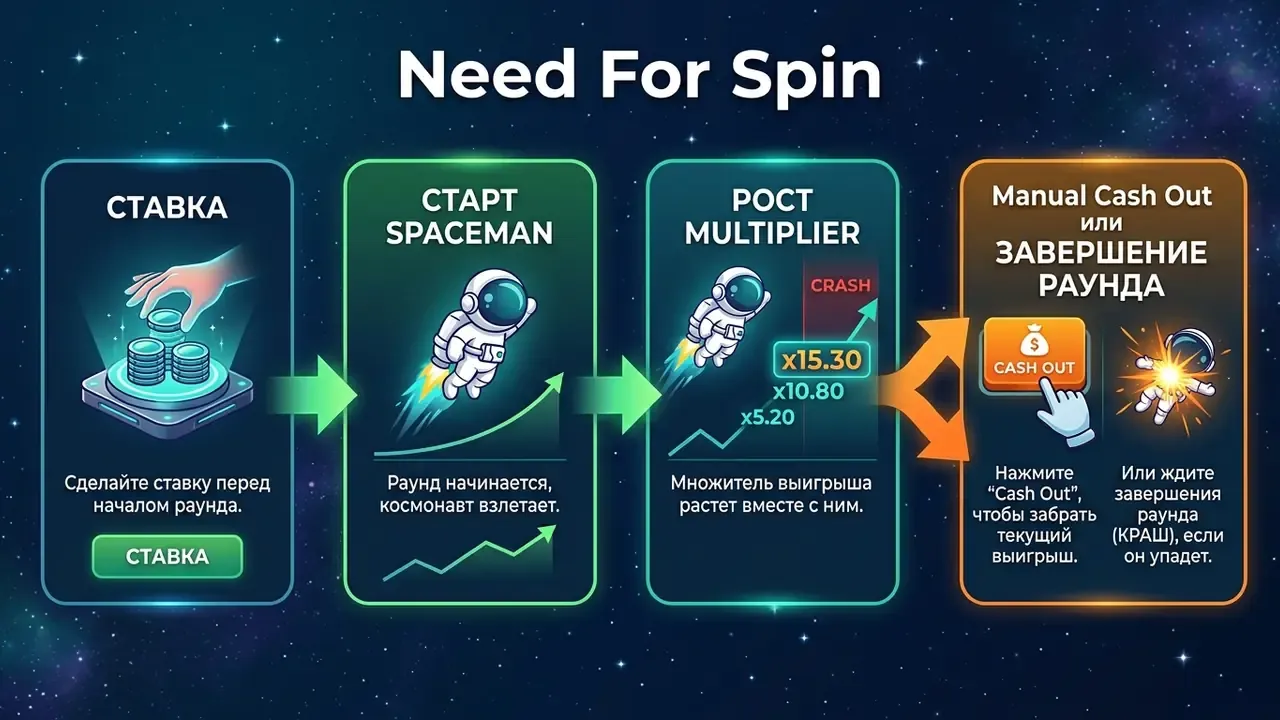
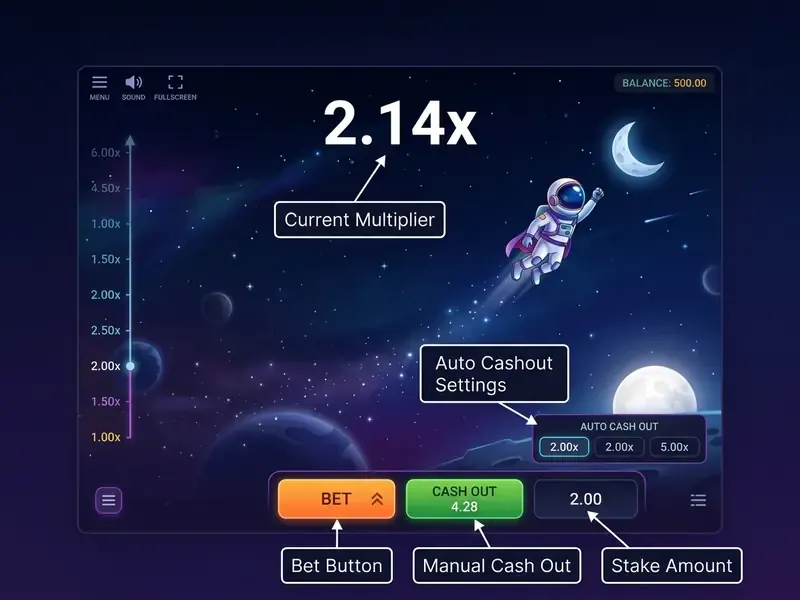
  1. Betting window opens. A countdown of roughly ten seconds runs while bets are accepted. The default stake shown is one coin; quick-add buttons increment the stake by 1, 5, 10 or 25 coins, and secondary controls let you double (2x Bet) or undo the entry.
  2. Confirm. The large green Confirm button locks the stake for the round. Once locked, the stake cannot be changed.
  3. Lift-off. The astronaut launches and the multiplier starts at 1.00x.
  4. Ascent. The multiplier rises continuously and never decreases. The Bet button becomes a Cash Out button.
  5. Decision. Press Cash Out (or 50% Cash Out) at any point. Payout = stake × multiplier at the moment of the click.
  6. Crash. The round terminates at a randomly determined point. Any stake still riding is lost.
  7. History updates. The horizontal strip of past results and the statistics panel record the round; the live side panel shows other players' stakes, exit multipliers and payouts.
One-Round Game Flow From Stake to

How the Multiplier Determines the Outcome of a Round

The multiplier is the entire pay table. Cash out at m on a stake of s and you receive s × m; fail to cash out and you receive nothing. Since m only ever increases, the strategic problem is exclusively one of stopping time.

The shape of the distribution is what most players never see. In a fairly configured crash game with a stated return of 96.5%, the probability of surviving to a multiplier m is approximated by:

P(M ≥ m) ≈ 0.965 / m

That yields the following practical picture:

Multiplier targetApprox. probability of reaching itPractical risk level
≥ 1.10x~88%Very low
≥ 1.50x~64%Low
≥ 2.00x~48%Medium
≥ 5.00x~19%High
≥ 10.00x~10%Very high
≥ 100.00x< 1%Extreme
≥ 1,000x~0.1%Lottery-tier

Read the 2.00x row carefully. A "double your money" exit is closer to a coin flip that you lose slightly more often than you win. The much-repeated advice to "just wait for 10x" is a request to lose roughly nine rounds out of ten.

Empirical work on specific crash games supports this picture.

«Very high multiplier outcomes do occur, but they constitute a negligible share of rounds; the majority terminate at low values.» - Cash or Crash, UNLV Center for Gaming Research

Two consequences follow. First, expected value is essentially flat across cash-out targets in a fairly configured game: pushing for higher multipliers buys variance, not edge. Second, the distribution of session outcomes is wildly different between a 1.2x strategy and a 50x strategy, even where the long-run expectation is identical. Choose according to the ruin risk you can tolerate, not according to the headline number.

Control Panel, Bet Sizing and Round Intervals

The interface is compact and, once decoded, unusually informative:
  • Bottom centre:stake field and Confirm button; quick-add chips (+1, +5, +10, +25); undo; 2x Bet.
  • Bottom left:balance.
  • Bottom strip:the ribbon of previous round results. Useful as a record of variance, useless as a predictor.
  • Statistics menu(three-line icon next to Confirm): expanded round data and history, including hash strings for completed rounds.
  • Bottom right:live feed of other players' bets, exit multipliers and winnings.
  • Top right:game history, help and info panel (where jurisdictional RTP is displayed), volume, sound effects, language and animation toggles.
Control Panel, Bet Sizing and Round

Round cadence is fast: a short betting window, a flight of a few seconds, then the next countdown. That tempo is the central risk factor of the format. A slot player might complete a few hundred spins in an hour; a crash player can complete a comparable number of decisions, each one demanding active attention.

Two Bets in One Round

Spaceman's betting layout allows two stakes in the same flight, which enables a split-target approach: one bet with an early auto cash-out to recover the round's cost, a second bet held for a higher target. This is genuine variance shaping. It does not raise expected return, and it does raise total exposure per round. If you use it, count your combined stake as the real bet size when applying bankroll rules, not the individual line.

One small observation from testing. Players who run two fields almost always drift upward on the second line, because the first line "already paid for the round". That is a budgeting illusion. The money on the second field is the same money.

Two Bets in One Round. Spaceman's

Cashing Out in Spaceman: Manual, Auto and 50% Cash-Out

Manual Cash-Out: Timing Decisions and Behavioural Dynamics

Manual cash out is the game's defining act. Reaction speed matters at the margin, and network latency is a real, if small, tax: the payout registers when the server accepts the click. Players targeting sub-1.20x exits on an unstable connection should widen their margin or switch to Auto Cash Out.

The larger issue is not reflex but psychology. Every held second increases the potential payout and the probability of losing everything at the same time. This trade-off between potential gain and risk of ruin is the core strategic tension in crash games, and it has been studied both mathematically and behaviourally.

Manual Cash-Out Timing Decisions and Behavioural

«When a cash-out option was available, participants placed bets that were on average 35% larger than without it.» - Psychological Science (2024)

That finding is uncomfortable and important. The feature that feels like a safety valve is associated with larger stakes, not smaller ones. The perceived ability to exit reduces felt risk, and reduced felt risk expands wagering.

The same literature documents which direction the asymmetry runs.

«Participants inclined to exit when odds worsened were less likely to lock in profit when odds improved, a pattern consistent with the disposition effect.» - Psychological Science (2024)

In other words, cash-out behaviour is not neutral risk management. It systematically cuts losses quickly and lets gains ride, an asymmetry aligned with the disposition effect and loss aversion.

Transaction-level sportsbook data analysed in a separate study points the same way: cash-out usage is non-random and strongly shaped by a disposition to lock in small gains or to prevent total loss. We flag this as preliminary. The accessible abstract does not report the sample size, the observation period, or the operator population, so the direction of the effect is more credible than its magnitude. Treat it as a hypothesis consistent with experimental work, not as a measured parameter, pending publication of the full methodology.

Survey data collected specifically on crash-game and cash-out users gives the player-stated motives:

In other words, cash-out behaviour is

«Approximately half (51.8%) reported using the cash-out feature… The primary reasons given were to access money immediately, to cut losses, and because cashing out felt like a less risky option.» - Spaceman Online Crash Game: An Evidence-Based Report on Demo Play, Real Money Gambling and Risk Features (2025)

Note the third motive: it felt like a less risky option. Feeling and expectation are different objects. For a fixed cash-out target c, the expected return per unit stake is c · P(M ≥ c), and in a fairly configured game that expectation is always below one for any valid cash-out strategy. No timing rule converts a negative-expectation game into a positive one, and over enough rounds the arithmetic asserts itself:

«The ratio of total profit to total wagered converges almost surely to minus the house advantage under any bounded strategy.» - Long-term behavior of casino games, preprint (2026)

That is the whole ceiling of strategy here. Strategy in Spaceman is not a route to profit; it is a method of choosing how you lose, slowly and predictably, or quickly and dramatically.

Auto Cash-Out and 50% Auto Cash-Out: Settings and Maths

Auto Cash Out lets you pre-set a target anywhere from 1.01x to 4,999.99x; the system exits automatically when the multiplier reaches it. Its value is not statistical but procedural. It removes reaction time, latency and hesitation from the equation, and it enforces a decision you made calmly before the round rather than one you improvise mid-flight.

50% Cash Out is the feature that genuinely separates Spaceman from most crash titles. It banks half your position at the current multiplier and leaves the other half riding. It can be used once per round: after splitting, the riding half can be cashed out later or left to crash, but you cannot split again.

Worked example, the stake-recovery exit at 2.00x:

  • You bet $10.
  • At 2.00x you press 50% Cash Out. Half your stake ($5) is settled at 2.00x, so $10 is credited immediately. Your original stake is now fully recovered.
  • $5 keeps flying.
  • If the astronaut reaches 4.00x and you exit, that half returns $20. Round total: $30 from a $10 bet.
  • If it crashes at any point after the split, you keep the banked $10 and lose the riding $5. You break even on the round.

Worked example, the profit-taking exit at 4.00x:

  • You bet $10 and hold to 4.00x, where the full position is worth $40.
  • Pressing 50% Cash Out pockets $20 instantly and leaves $20 riding.
  • A crash costs you only the riding half; the banked $20 is untouchable.

Mathematically, the split does not raise expected value. It compresses the variance of the round and, in the 2.00x case, removes the possibility of a losing round entirely while preserving upside on half the position. For players whose main failure mode is emotional escalation after total washouts, that structural break matters more than any theoretical edge.

Auto Cash-Out and 50 Auto Cash-Out

Autoplay, 2x Bet and a Risk Warning

Autoplay repeats your baseline stake across consecutive rounds, usually combined with a pre-set Auto Cash Out. 2x Bet doubles the stake for the next round in one click. Both are convenience features with measurable behavioural cost.

«Bayesian time-series analyses reveal that introducing autoplay to casino games leads to a significant 6.9-9.1% increase in the total amount wagered over time and roughly a 3% increase in the number of spins.» - Spaceman Online Crash Game: An Evidence-Based Report on Demo Play, Real Money Gambling and Risk Features (2025)

Warning: autoplay removes the natural pause between rounds, which is the exact moment a player would normally reconsider the budget. Combine that with a one-click stake-doubling button and the interface is escalating for you. If you use autoplay, set a hard loss limit and a round count before you start the series, and treat those limits as non-negotiable rather than as suggestions.

Multiplayer Chat and Live Leaderboards

Unlike a slot, Spaceman is a shared round. Every active player sees the others' stakes and exit points in real time through the chat and live-bet panels, and daily, monthly and yearly leaderboards rank the biggest cash wins and highest multipliers achieved.

This social layer is more than decoration. It is an accidental transparency mechanism. Watch it for twenty minutes and you will see, with your own eyes, that nobody, including the loudest self-declared predictors, beats the curve consistently. Streaks of high multipliers on the results ribbon are followed by nothing in particular. That is a more effective inoculation against pattern-hunting than any paragraph of probability theory.

Multiplayer Chat and Live Leaderboards. Unlike

RTP, Win Potential and Risk in Spaceman

This information is general in nature and is not a substitute for professional advice. Gambling involves a risk of financial loss; play responsibly and only within limits you set in advance.

How RTP and Return Help You Compare Casino Games

Spaceman's stated RTP is 96.50%, subject to jurisdictional configuration. Against the typical online-casino band of roughly 95-97%, that sits at the upper-middle of the market. In expectation terms it means a house edge of 3.5%: across a very large number of rounds, the model returns about 96.5 units for every 100 wagered.

Two clarifications most reviews skip. First, RTP is a long-run property of the game model, not a promise about your session; short sequences deviate enormously in both directions. Second, RTP says nothing about the shape of the returns, and shape is where crash games differ most from slots.

How RTP and Return Help You

«DraftKings Rocket, advertising a 97% RTP, exceeds typical Atlantic City slot RTPs of around 91-92%, yet its payout distribution remains heavily skewed.» - UNLV Center for Gaming Research, analysis of DraftKings Rocket

A higher headline RTP with a heavily skewed distribution can produce a worse subjective experience than a lower RTP with flatter payouts, because most of the theoretical return sits in outcomes you will rarely see. Judge a crash game on RTP and on the multiplier distribution, never on RTP alone.

Also worth noting: a stated 97% still implies a 3% house edge. There is no configuration of a commercial crash game in which the player holds the mathematical advantage.

Why a High Maximum Multiplier Does Not Guarantee a Win

The 5,000x ceiling is the game's marketing centrepiece and its most misleading number. Three points dismantle the implication.

1. Rounds are independent. Each round is a fresh draw from the same distribution. A 1,000x flight does not make the next round more likely, or less likely, to fly high. Believing otherwise is the gambler's fallacy: randomness does not compensate for previous outcomes, and the results ribbon at the bottom of the screen contains no exploitable information about the next round.

2. The tail is extraordinarily thin. Under the 0.965/m model, outcomes above 100x occur in well under 1% of rounds, and 1,000x-plus in roughly one round in a thousand. Most rounds crash much earlier, and only a small fraction of sessions will ever see multipliers in the hundreds or thousands. A methodological note: we have found no published, audited per-round frequency table for Spaceman specifically, so this statement rests on the general crash-curve model and on the UNLV finding that very high multipliers are a negligible share of rounds in comparable games. Any source presenting exact Spaceman hit rates without a provider or laboratory reference should be treated as estimating, not reporting.

3. The ceiling is a design constraint. As the crash-engine modelling quoted earlier shows, the round is terminated when the worst-case payout would breach the engine's budget. The 5,000x figure describes what the software permits, not what the distribution delivers.

The astronaut can also crash almost immediately, at multipliers barely above 1.00x. Any strategy that assumes a minimum flight duration is unfounded.

Why a High Maximum Multiplier Does

Volatility: Why the "Low Volatility" Label Is Misleading

Several reviews assign Spaceman "low volatility" and then advise placing large stakes on small multipliers as a way to "win frequently". Both halves of that need correcting.

Crash games do not carry a fixed, artificial volatility profile in the slot sense, because the player selects the variance. Cashing out at 1.10x produces frequent, tiny wins and occasional losses, which reads as a low-volatility experience. Holding for 50x produces a long chain of losses punctuated by rare large wins, which is extreme volatility. The accurate description is flexible, player-defined volatility.

And the "large stakes on small multipliers" advice is dangerous precisely because it sounds conservative. At a 1.10x target you win roughly 88% of rounds, but each loss wipes an entire stake that was sized on the assumption of near-certainty. A single early crash erases the profit of many successful rounds, and if the stake was inflated to compensate for the thin margin, the drawdown is severe. Frequency of winning is not the same thing as safety of capital.

Volatility Why the Low Volatility Label

Fairness and Verification

RNG, Certification and Round-History Hashes

Spaceman's outcomes are generated by a random number generator inside a client that is subject to third-party laboratory testing under Pragmatic Play's licences. The interface exposes a round-history panel containing hash strings; players comfortable with SHA-256 can inspect the decrypted strings tied to completed rounds and confirm that published results match the recorded data.

What this does and does not give you:

  • Does: independent laboratory certification of the RNG, an auditable round history, and outcomes that cannot be altered retroactively by an operator.
  • Does not: the blockchain-style, seed-and-nonce verification workflow familiar from crypto crash games. See the caveat in the Pragmatic Play section above. Reviews asserting full blockchain-grade provable fairness for Spaceman are, in our assessment, over-claiming without a provider technical document to cite.
RNG, Certification and Round-History Hashes. Spaceman's

Pragmatic Play Licensing and Jurisdictions

Pragmatic Play holds active licences and certifications across a broad set of regulated markets, including the UK Gambling Commission, the Malta Gaming Authority, the Gibraltar regulator, iGaming Ontario (with operators licensed by the Alcohol and Gaming Commission of Ontario under the Gaming Control Act, 1992), Sweden's Spelinspektionen and the Danish Gambling Authority. Practical consequence: Spaceman is legitimately available wherever the provider's library is certified, and the version you play in a regulated market is subject to that market's technical standards and player-protection rules.

Age and territorial rules are set locally. Ontario requires players to be 19+ and physically present in the province, while Alberta operates an 18+ threshold. Verify your own jurisdiction before depositing, and check that the operator lists your province in its terms.

Pragmatic Play Licensing and Jurisdictions. Pragmatic

Spaceman Demo and Free Play: Testing the Game Without Risk

What You Can Test in Spaceman Demo Mode

The spaceman demo is a free-play version running the same maths model as the real-money game, credited in virtual coins with no withdrawal rights. In 2026 it is reachable through the provider's own site (pragmaticplay.com, no registration), through certain licensed operator lobbies with an account, and through review portals embedding the official Pragmatic Play client.

Use spaceman free play for four concrete tasks, not for "warming up":

  1. Auto Cash-Out calibration. Run 10-20 complete rounds at each of 1.20x, 1.50x, 2.00x and 5.00x and record the hit rate you actually observe. Compare it against the probability table above. This is the fastest cure for high-multiplier fantasies.
  2. 50% Cash-Out mechanics. Execute the split at 2.00x and at 4.00x until the payout arithmetic is intuitive rather than calculated. Confirm for yourself that the feature is once per round.
  3. Interface and timing. Learn where Confirm, Cash Out, statistics and history sit, and how long the betting window really lasts, so no real-money round is lost to a misclick or a late confirmation.
  4. Round intervals and session pace. Time how many rounds you complete in ten minutes, then multiply by your intended stake. Most players discover that their planned session cost is two to three times what they assumed.

One honest limitation. Broader gambling research has documented that players often treat play-money and real-money gambling differently, with demo play sometimes underestimating the impact of loss aversion. We were unable to identify a primary study measuring this specifically for crash games, so we present it as a documented tendency in the wider literature that requires game-specific data before being quantified. The practical implication stands regardless: a cash-out discipline that feels effortless with virtual coins frequently collapses on the first real losing streak.

What You Can Test in Spaceman

Demo vs Real Money: Identical RNG, Different Player

Two things are true at once. The randomisation logic is the same in both modes. There is no separate, friendlier RNG for demo play, and demo results are not tuned to encourage a deposit. And the player is not the same in both modes: real stakes bring loss aversion, urgency and physiological arousal that virtual credits do not.

That is why demo mode is excellent for learning mechanics and poor for validating strategies. A 200-round demo sample proves nothing about the profitability of a target multiplier. What it can prove is whether you are able to obey your own rule when the number on screen keeps climbing.

Demo vs Real Money Identical RNG

Demo mode exists solely to familiarise players with game mechanics and does not reflect the financial outcomes of real-money wagering. Success in free play is not a predictor of real-money results. Set time and stake limits before you switch modes.

Playing Spaceman Online for Real Money

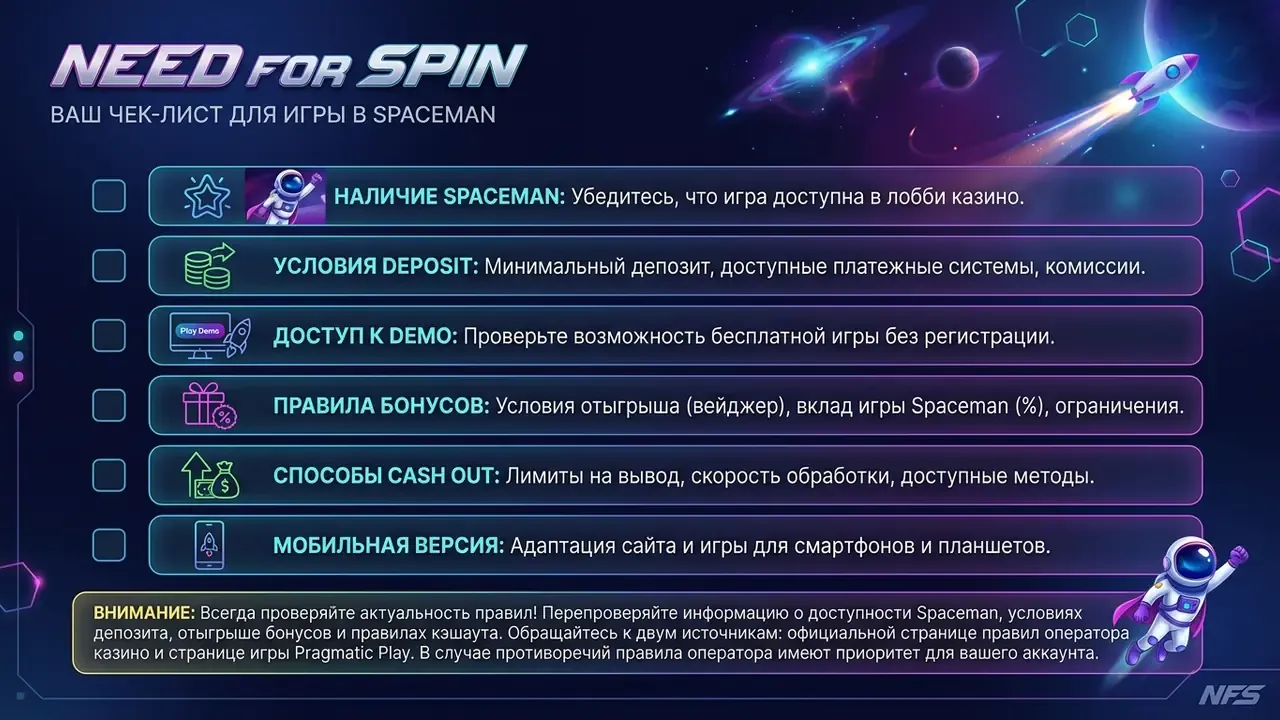
What to Check Before Choosing a Spaceman Casino

Because Spaceman is a supplier product rather than an operator product, you have to choose an online casino that carries the game and satisfies regulatory and trust criteria. The provider's certification protects the game's integrity. It does not protect your balance from a badly run operator.

«If a gambling site doesn't display a UKGC licence number… do not deposit.» - UK Gambling Commission guidance for players

The reasoning generalises. With an unlicensed operator you have effectively no dispute route, and no regulator to escalate to.

Four checks before you deposit:

  1. Licence. An active, verifiable licence number in the register of MGA, UKGC, AGCO and iGaming Ontario, or another recognised regulator, checked on the regulator's own website rather than on the casino's footer graphic.
  2. Software. Spaceman appears in the lobby under the genuine Pragmatic Play provider filter, with the provider logo on the game tile. Clone titles with similar art and no provider attribution are a red flag.
  3. Payouts. Withdrawal processing terms stated clearly in the T&Cs, with a pending period no longer than 24-72 hours absent a documented reason.
  4. Payments and currency. Local methods supported. For Canadian players Interac e-Transfer is typically the fastest route, with e-wallets and major cryptocurrencies as common alternatives, and no forced double currency conversion out of CAD.

Add to that: SSL and HTTPS throughout, transparent deposit and bet limits, working responsible-gambling tools, mobile responsiveness, and live support you can actually reach.

The reasoning generalises. With an unlicensed

The Player Path: From Deposit to Cash Out

  1. Register at a licensed operator and complete identity verification (KYC) early, not at the moment you request a withdrawal.
  2. Set limits first. Deposit limit, loss limit, session-time reminder. Doing this before your first deposit is materially easier than doing it after a losing session.
  3. Deposit using a method you can also withdraw to. Mismatched deposit and withdrawal channels are the most common cause of delayed payouts, especially with Interac.
  4. Locate Spaceman in the crash-game or Pragmatic Play section of the lobby and confirm the provider attribution.
  5. Check the in-game info panel for the RTP configured in your jurisdiction.
  6. Set your stake inside the betting window, and configure Auto Cash Out if you intend to use it.
  7. Play your pre-decided plan: target multiplier, stake size, round count, loss cap.
  8. Withdraw to your original payment method, allowing for the stated pending period and any per-transaction caps.

Outcomes in this format are binary at round level. Cash out before the crash and your payout equals stake × multiplier; miss it and the full stake is gone with no recovery mechanism. Budget accordingly.

The Player Path From Deposit to

Spaceman Mobile: What Changes and What Does Not

The client is responsive, so spaceman mobile play runs in a browser on phones and tablets without a separate app in most lobbies. Rules, RTP, bet range and the 5,000x ceiling are identical to desktop. What changes is the ergonomics: a smaller Cash Out button, a shorter thumb travel, and a connection that may drop mid-flight.

Two practical adjustments. Use Auto Cash Out on mobile more than you would on desktop, because a dropped connection during an ascent is the one scenario where hesitation is not your decision. And do not open a second account to play on a phone. Almost every licensed operator permits one account per person, and duplicate accounts are a standard reason for a withheld withdrawal at KYC.

Spaceman Mobile What Changes and What

Bonuses and Spaceman: Read the Contribution Rules

Spaceman contains no built-in bonuses. No free spins, no bonus round, no bonus buy. Everything promotional attached to it comes from the operator side: welcome packages, reload offers, occasional no-deposit credits or free bets.

The critical detail is wagering contribution. Free spins from welcome packages are usually restricted to slots and rarely apply to crash games, and crash titles frequently contribute at a reduced percentage, or are excluded outright, from wagering requirements. Before accepting a bonus with the intention of clearing it on Spaceman, find the game-contribution table in the T&Cs and read it line by line. A bonus you cannot clear on your game of choice is a restriction on your balance, not a gift.

Watch two more clauses while you are in there: maximum bet while a bonus is active (often $5 or $8, which a $25 crash stake breaches instantly) and max cashout on winnings from bonus funds. Both can quietly cancel a good session.

Bonuses and Spaceman Read the Contribution

Spaceman Strategy: Cash-Out Discipline and Common Errors

A framing note that most "strategy" content omits: no staking pattern alters the house edge. What staking patterns alter is the distribution of your session outcomes and the probability of ruin within a finite bankroll. Read everything below in that light.

Early Cash-Out and a Fixed Bet Size

The low-risk archetype in Spaceman is a fixed stake with an early automatic exit, typically 1.10x-1.30x, occasionally up to 1.50x. Its properties:
  • Hit rate:roughly 75-88% of rounds at these targets.
  • Per-round exposure:constant, because the stake never changes.
  • Failure mode:a cluster of early crashes. At a 1.20x target, a run of six consecutive losses is uncommon but entirely normal, and it costs six full stakes while each win returns only 20% of one.
Early Cash-Out and a Fixed Bet

Fixed staking earns its place not by improving expectation, which it cannot do, but by capping per-round variance and, more importantly, by removing the decision that does the most damage: changing the stake in response to the last result.

«Under reactive staking, the probability of ruin f(x,p) exhibits a complex dependence on the initial bankroll and the bias of the game.» - How reactive gambling can backfire, preprint (2025)

That 2025 preprint on reactive gambling shows that when players raise stakes after losses, the probability of eventual ruin can be higher than for non-reactive strategies. Which directly contradicts the intuition behind every loss-recovery system ever sold.

Practical rules that follow from the maths:

  • Size a single stake at roughly 1-2% of the session bankroll, and count combined stakes if you run two bets per round.
  • Fix the stake for the entire session, in advance.
  • Set a loss cap (say 20% of the session bankroll) and a win cap, and use the operator's tools to enforce them rather than your willpower.
  • Use Auto Cash Out to execute the plan, plus a hard round count if you enable autoplay.
  • Never treat a "safe" low target as licence to raise the stake. The margin is thin precisely because the losses are rare and total.
That 2025 preprint on reactive gambling

Chasing Multipliers, Martingale and Reactive Betting Errors

Three failure patterns account for the overwhelming majority of fast bankroll destruction in crash games, and all three are variations on the same mistake: increasing exposure when variance is unfavourable.

Martingale and negative progressions. Doubling after each loss to recover with a single win means exposure grows geometrically during exactly the streaks that occur naturally in a game where sub-2x crashes are the majority outcome. Table limits, bet caps ($100 in Spaceman) and finite bankrolls guarantee the progression terminates before the "guaranteed" recovery arrives. Eight consecutive losses from a $1 base requires a $256 stake, above the game's maximum.

Chasing Multipliers, Martingale and Reactive Betting

«An improved Martingale betting system raises average returns in index-futures trading, but the result depends on market inefficiencies that do not exist in casino games.» - IMBS for TAIEX index futures (2023)

The 2023 paper on an improved Martingale betting system for intraday index-futures trading offers another cautionary tale, and the boundary is the important part. In markets, progressive staking can interact with mean reversion, autocorrelation and informational structure. In a certified RNG crash game there is no structure to interact with: rounds are independent and the edge is fixed. Transplanting a market staking system into a casino game imports the risk profile and leaves the mechanism behind.

Chasing 1,000x+. Hunting the extreme tail means accepting a hit rate around one in a thousand. Sessions built on that target are, in practice, a long sequence of total losses; the expected value is no better than a 1.20x approach, while the probability of ending the session at zero is far higher.

Tilt and loss-chasing. Re-betting out of frustration after a losing streak is documented in behavioural research as loss-chasing: stakes driven by an urge to recover rather than by any read on probability. Combined with a one-click 2x Bet button and autoplay, it is the fastest route to a session that outruns its budget. Recognise the state, which shows up as rising stakes, shrinking patience and an abandoned target multiplier, then stop the session. Not the round. The session.

A fourth misconception deserves naming: that small stakes make play safe. Total risk is a function of stake size × frequency × duration × total capital exposure. Spaceman's rapid round cadence means a "small" stake, repeated for two hours with autoplay, can represent a larger cumulative exposure than a handful of large slot spins.

The 2023 paper on an improved

Session Limits and Time Management

Set the time budget before you open the game, not after the first drawdown. Use the operator's deposit and loss limits, session reminders, cool-off and self-exclusion tools; regulated operators in Ontario and other licensed markets are required to provide them. Watch for the format-specific warning signs: extending a session because of a near miss, raising the target multiplier after a win, raising the stake after a loss, or leaving autoplay running while you do something else.

Responsible Gambling

Gambling involves a real risk of financial loss, and no strategy described in this article changes that. Three evidence-based practices are worth stating plainly:

  • Deposit and time limits. Regulators including the UK Gambling Commission require licensed operators to provide deposit limits, time-outs and self-exclusion. Use them before you need them.
  • Demo results are not predictions. Responsible-gambling guidance from services such as GamCare is explicit that free-play outcomes do not guarantee real-money results, because real play involves actual stakes and actual risk.
  • Budget your time as well as your money. Setting a time budget before play, alongside a spending limit, is a standard control recommended by the National Council on Problem Gambling.

If gambling is affecting your mental health, finances or relationships, contact a local support service. In Ontario, ConnexOntario is reachable at 1-866-531-2600 or by texting CONNEX to 247247; in Alberta, dial or text 211. Age restrictions apply: 18+ or 19+ depending on jurisdiction.

Compare on the facts, read the terms before you deposit, and play within limits you set yourself.

This article is informational and does not constitute financial, legal or medical advice.

Responsible Gambling. Gambling involves a real

FAQ

Appendix A: Corrections and Fact-Check

Several widely circulated claims about Spaceman are inaccurate. We record them here with the corrected data, so readers arriving from other reviews can reconcile the discrepancy.

Claim found in circulationStatusCorrect position
"RTP is 97%"ContradictedStated RTP is 96.50%; 97% is a different game's figure or an editorial error.
"Spaceman is a new crash game released in 2025"ContradictedReleased in early 2022 (announced 22 February 2022).
"Spaceman is a slot / has paylines / has a bonus buy"ContradictedCrash game: no reels, no paylines, no bonus buy, no free spins.
"Low volatility, you'll win frequently"Needs qualificationVolatility is player-defined; the phrase describes an early-cash-out style, and pairing it with larger stakes increases drawdown risk.
"Place large stakes on low multipliers to improve your odds"MisleadingRaises hit rate, raises absolute loss per crash, does not improve expectation.
"Max win 5,000x; stakes $1-$100"SupportedConfirmed across provider and licensed-operator sources.
"Autoplay increases total amount wagered by 6.9-9.1%"SupportedBayesian time-series analysis, 2025 evidence-based report.
"Fully provably fair in the blockchain sense"UnverifiedCertified RNG plus round-history hashes confirmed; blockchain-grade self-verification not documented.