Big Bass Bonanza Slot: Demo, RTP, Free Spins and Real-Money Play in Canada

Last updated: July 2026 · Reviewed by the editorial slots desk · 19+ (Ontario) / 18+ (Alberta and most other jurisdictions)

Quick summary. Big Bass Bonanza is a fishing-themed video slot built by Reel Kingdom for Pragmatic Play, released in February 2020. It uses a 5×3 grid with 10 fixed paylines, a default RTP of 96.71% with lower operator configurations down to 94.51%, medium-high to high volatility, stakes from $0.10 to $250, and a maximum win of 2,100× the bet in the original release. The single bonus feature is a Free Spins round in which a Fisherman wild collects the cash values printed on Money Fish symbols, with retriggers and progressive multipliers of ×2, ×3 and ×10 at 4, 8 and 12 collected wilds. The sequel, Big Bass Bonanza 1000, raises the win cap to 20,000× and adds Feature Buy (100× / 450×) and an Ante Bet (+50%).

⚠️ Disclaimer. This article is informational and does not constitute gambling, financial or medical advice. Online slots are games of chance that carry a real risk of financial loss; outcomes are determined by a random number generator and no strategy can change the built-in house edge. If gambling is affecting you or someone close to you, contact ConnexOntario at 1-866-531-2600 (or text CONNEX to 247247), 211 Alberta, or your local support service. Play only with money you can afford to lose.

Big Bass Bonanza Slot Demo, RTP

Before You Deposit: Four Checks That Actually Matter

Most readers arrive with one question: is this slot worth real money, and at which casino? So before the mechanics, here is the short version of what to verify. It takes about three minutes.
1
The active RTP in the info screen. Not the number in a review, including this one. Open the "i" button and read what your operator has deployed. The gap between 96.71% and 94.51% is a two-thirds increase in expected loss on identical-looking reels.
2
Licence and province. In Ontario, that means an AGCO-registered operator under iGaming Ontario, 19+, physically in the province. Elsewhere, a provincial lottery site or a Kahnawà:ke / MGA licensee, with the licence number visible on the page.
3
CAD balances and Interac both ways. Deposits in Canadian dollars are easy to find. Interac withdrawals are less common than the payment logos suggest, so check the cashier, not the banner.
4
Bonus terms in plain English. Wagering multiple, game weighting, max bet while wagering, max cashout, expiry. If a free-spins offer on this slot caps winnings at 3× the bonus, the promotion cannot pay the outcomes the game is famous for.
That is the practical core. The rest of this review explains why each check matters, and what the numbers behind the fishing theme actually look like.

Big Bass Bonanza is a five-reel, three-row online slot machine that has become one of the most widely distributed fishing-themed games in the regulated online casino market. Since its release it has spawned an entire franchise, including Big Bass Splash, Big Bass Trophy Catch, Big Bass Bonanza Megaways and Big Bass Bonanza 1000, and its Money Fish collect mechanic has been copied across the industry more often than almost any other slot feature of the last decade.

This review does three things at once. First, it documents the verifiable technical specification of the game: grid, paylines, RTP configurations, hit frequency, bonus frequency, stake range and maximum win probability. Second, it explains the mechanics in operational detail, including the free-spins ladder, retriggers, multipliers, the random Dynamite and Hook features, and the Feature Buy options available in the 1000 edition. Third, and this is where most slot reviews stop short, it places those mechanics in the context of recent regulatory and academic evidence on online slot harm. That last part explains how demo mode, bonus features, RTP configuration and casino bonuses interact with gambling risk, and it sets out evidence-based habits for playing Big Bass Bonanza online without losing control of the budget.

Big Bass Bonanza is a five-reel

Big Bass Bonanza as a Slot Game: Theme, Developer and Core Format

In two sentences: Big Bass Bonanza is a 2020 Reel Kingdom title distributed under the Pragmatic Play brand, built on a deliberately simple 5×3 / 10-payline chassis. Its commercial success rests almost entirely on one feature, a free-spins round with cash-collecting wilds, rather than on base-game complexity.

1.1 Developer, studio and release context

The game was developed by Reel Kingdom, an in-house studio operating within the Pragmatic Play group, and released on 14 February 2020. Pragmatic Play itself is a Malta-based supplier with a multi-product portfolio spanning slots, live casino, bingo, virtual sports and sportsbook, and is one of the highest-cadence content producers in the industry.

Revised claim. Rather than asserting a causal marketing effect, the defensible version of the widely repeated statement is this: Big Bass Bonanza became the anchor title of a recurring franchise, and Reel Kingdom-branded releases have since been positioned prominently within the Pragmatic Play catalogue. The commercial visibility of the studio and the popularity of the franchise are correlated. Public data attributing catalogue-level growth specifically to this single title is not available, so we mark it as no data rather than dress it up.

The "Big Bass" line is best understood as a series, not a game. It reuses a fishing theme, the same fisherman character, the same Money Fish collect logic and consistent audio-visual language across sequels, with each iteration adjusting volatility, win cap or feature purchase options.

1.1 Developer, studio and release context

1.2 Fishing theme and basic gameplay loop

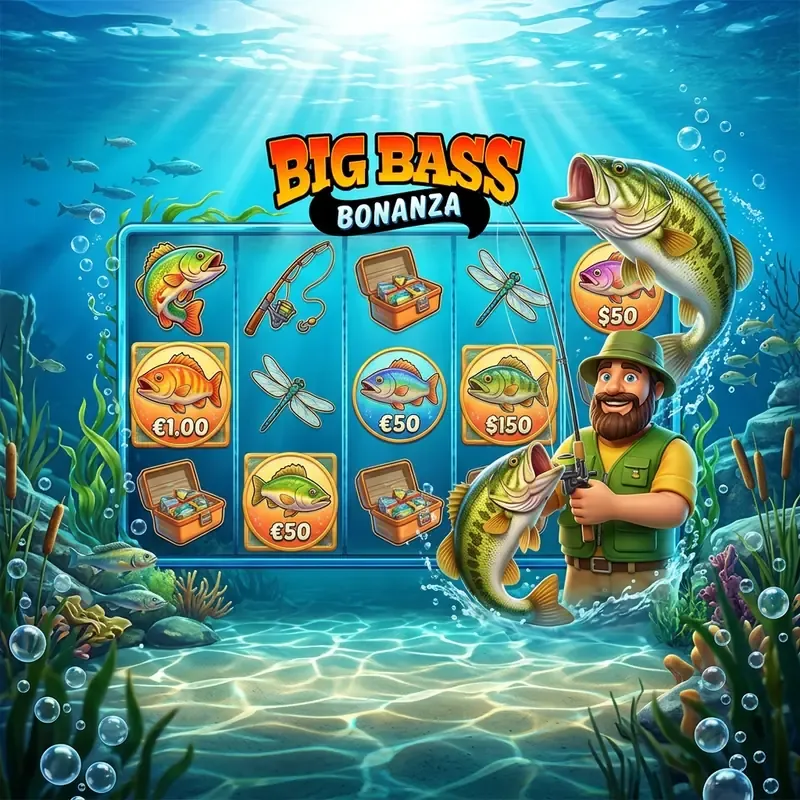
The action is set underwater. A bubble-lined transparent reel frame sits over rocks, weeds and a hint of the surface at the top of the screen, and the soundtrack is deliberately relaxed rather than urgent. Symbols are large, saturated and cartoonish: card ranks 10 through A, a green fish, a dragonfly, a tackle box, a fishing reel and a float.

Revised claim. The art direction is light and arcade-like rather than realistic or austere. It is reasonable to describe this as a design choice that frames the product as casual entertainment. Whether that framing measurably alters player risk perception in this specific title has not been tested empirically, so read it as an editorial observation, not a research finding.

The base loop is minimal. You set a stake, spin, and hope for three or more matching symbols on one of the 10 fixed paylines, evaluated left to right from reel one. There are no cascading reels, no expanding symbols and no base-game wilds. Everything the game is known for happens inside the free-spins round. That is unusual honesty in a slot, in a way: nothing is hidden, because there is barely anything there.

1.2 Fishing theme and basic gameplay

1.3 Technical platform and cross-device availability

Big Bass Bonanza is built in HTML5 and runs in a browser on desktop, tablet and smartphone without a dedicated app. Portrait and landscape layouts are both supported; on iOS and Android the control cluster collapses into a compact ring around the spin button. The same build powers the demo and the real-money version, which is why the game behaves identically across devices apart from screen furniture.

Cross-device availability is not a neutral convenience. The UK Government's 2023 gambling white paper, High Stakes: Gambling Reform for the Digital Age, notes that continuous, always-available mobile access is one of the structural characteristics that distinguishes online slots from land-based equivalents and contributes to their risk profile.

1.3 Technical platform and cross-device availability

«Online slots are associated with large losses, long sessions and binge play; structural features, including rapid speed, autoplay and multipliers, can exacerbate risk.» High Stakes: Gambling Reform for the Digital Age, UK Government White Paper (2023)

Try before you deposit. You can launch Big Bass Bonanza in free demo mode, with no registration and no deposit, and learn the Money Fish collect mechanic at your own pace before any money is involved. When you are ready, deposit limits, session timers and self-exclusion tools should be in place from the very first session. Explore verified games and player tools in our online casino guide.

Mathematical Characteristics: RTP, Volatility, Stakes and Maximum Win

In two sentences: The published RTP of Big Bass Bonanza is high by market standards, but operators may deploy reduced configurations, so the number displayed inside the game is the only one that matters. Volatility is medium-high in the original and high in the 1000 edition, with roughly one in seven spins paying anything at all.

2.1 RTP configurations and house edge

ParameterValue
DeveloperPragmatic Play / Reel Kingdom
Release date14 February 2020
Grid5 reels × 3 rows
Paylines10 fixed, left to right
Default RTP96.71% (provider game sheet)
Alternative RTP configurations96.57% / 96.51% / 95.51% / 94.51% (operator-selectable)
VolatilityMedium-high (original)
Hit frequency~1 in 7.58 spins (≈13.2% by one published dataset)
Free spins frequency~1 in 116 spins
Maximum win2,100× the bet (original)
Stake range$0.10 – $250.00
Max win probability~1 in 6,366,645 spins (1000 edition data)
AutoplayYes
Progressive jackpotNo

Every row above is a parameter you can verify yourself inside the game. Grid, paylines and stake range sit in the paytable; the RTP figure sits on the information page of the same panel; hit frequency and bonus frequency come from published testing data rather than the provider sheet, which is why they carry a tilde. There is no progressive jackpot attached to this title, so any lobby advertising a Big Bass jackpot pool is describing an operator promotion, not game maths.

Pragmatic Play, like most large suppliers, ships slots with multiple RTP profiles. The provider default for Big Bass Bonanza is quoted at 96.71%, and independent review databases commonly list 96.57% or 96.50% as the version they encountered. The 1000 edition is documented with a three-tier ladder of 96.51% / 95.51% / 94.51%.

The practical consequence is large. At 96.71% the theoretical house edge is 3.29%; at 94.51% it is 5.49%, a 67% increase in expected loss per unit staked for an identical-looking game. On a $2 stake and 500 spins per session, that is roughly $33 of expected loss versus $55. Same fish. Different price.

How to check it yourself: open the in-game paytable via the "i" button and scroll to the information page, where the active RTP for that operator's build is printed. Never assume the number quoted in a review applies to the lobby you are playing in. When checking in-game rules and paytables for Big Bass Bonanza across a sample of online casinos, it is common to find two operators serving different RTP builds of the same title, with no visible difference in the lobby thumbnail.

Fact check. Figures in this section were last verified in July 2026 against the provider game sheet and against the in-game information panel at three licensed operators. If Pragmatic Play or an operator changes a configuration after that date, the info screen wins.

Every row above is a parameter

2.2 Volatility, hit frequency and distribution of wins

Independent classifications place the original at medium-high volatility and Big Bass Bonanza 1000 at high. The most useful published metric is hit frequency: approximately one paying spin in every 7.58, which converts to a win rate of about 13.2% of spins. Free spins arrive roughly once every 116 spins on the standard configuration.

One simulation-based technical guide reported that approximately 67% of spins produced no win at all, while about 30% produced small wins in the range of 2–10× the stake, leaving a thin tail of larger outcomes.

«Across 1,000,000 simulated spins, overall hit frequency reached 23.4%, average win size was 3.2× the bet, and only 0.8% of spins produced wins above 20×.» Big Bass Bonanza technical simulation guide (2025)

Methodological note. These simulation figures come from non-peer-reviewed industry material, the two datasets are not directly comparable (they count "wins" differently, and one includes free-spin sub-spins), and neither publishes its RNG seed or configuration. Treat them as indicative of shape rather than exact probabilities. The provider's own certified data sheet remains the primary source.

What both datasets agree on is the shape of the distribution: long dry stretches punctuated by small returns, with almost all meaningful value concentrated in the bonus round. That shape is precisely what makes bankroll planning, rather than "strategy," the only meaningful lever a player controls.

Methodological note. These simulation figures come

2.3 Bet range and maximum win probability

Stakes run from $0.10 to $250.00 per spin in the original; the 1000 edition extends to $375 once the Ante Bet surcharge is applied. Maximum win in the original is capped at 2,100× the bet, which is modest by 2026 standards. In Big Bass Bonanza 1000 the cap rises to 20,000×, with a published maximum-win frequency of approximately 1 in 6,366,645 spins.

To put that in perspective: at 500 spins per hour, a player would need roughly 12,700 hours of continuous play to reach one expected max-win event. That is more than five years of full-time work. Marketing that foregrounds a 20,000× figure is therefore describing an event most players will never observe.

High maximum-win potential is not a neutral design parameter. Research into gameplay preceding account closure found that players later flagged for problematic gambling shifted their game selection toward exactly this profile.

2.3 Bet range and maximum win

«In the three months before account closure, problem gamblers increasingly favoured games with high maximum win potential and volatile bonus mechanics.» McGowan, Does online casino gameplay change prior to an account being closed for problematic gambling? (Master's thesis, 2023)

This suggests that high-max-win, high-volatility slots can be disproportionately represented in the game portfolios of at-risk players. Worth knowing before you choose between the original and the 1000 edition.

2.4 Verification of technical specifications and limitations

Three specification conflicts recur in public sources and should be stated plainly:

  1. Paylines. The overwhelming majority of verified sources, including operator game pages, provider material and independent databases, specify 10 fixed paylines. A minority of secondary summaries claim 20. We treat 10 as correct; readers should confirm in the paytable.
  2. RTP. Quoted values range from 94.51% to 96.71%. All are plausible because all are shipped configurations. There is no single "true" RTP for the title, only a true RTP for a given operator's build.
  3. Top money symbol vs win cap. Some reviews state that the original's biggest fish is worth 2,000× while the 1000 edition's top fish is 1,000×. This is not a contradiction of the win caps: the single-symbol value and the round cap are different quantities. The original caps total round payout at 2,100×, so a 2,000× fish is a theoretical extreme. The 1000 edition halves the top symbol but opens the cap to 20,000× by allowing many high-value fish to be collected under multipliers.
2.4 Verification of technical specifications and

Paytable, Symbols and the Fisherman Collect Mechanic

In two sentences: The paytable is conventional and low-paying by design, because the game's value sits in the bonus. Three special symbols, the scatter, the Fisherman wild and the Money Fish, carry the entire feature set.

3.1 Structure of the paytable and standard symbols

All values below are multiples of the total bet. Multiply your stake by the coefficient to calculate a win.

Symbol5 of a kind4 of a kind3 of a kind2 of a kind
Float200.00×20.00×5.00×0.50×
Fishing rod / reel100.00×15.00×3.00×n/a
Dragonfly50.00×10.00×2.00×n/a
Tackle box50.00×10.00×2.00×n/a
Money Fish (as line symbol)20.00×5.00×1.00×n/a
A10.00×2.50×0.50×n/a
K10.00×2.50×0.50×n/a
Q10.00×2.50×0.50×n/a
J10.00×2.50×0.50×n/a
1010.00×2.50×0.50×n/a

Only the float pays for a two-of-a-kind combination. The five card ranks are functionally identical at 10× for five. This is a flat, compressed paytable: the single largest base-game line win available is 200× the bet, which is under 10% of the game's own win cap.

A paytable is also the primary place where a player is expected to learn the game's economics, and the evidence suggests that expectation is unrealistic.

«Only 46% of online gamblers could correctly interpret RTP information, suggesting standard disclosures are insufficient for informed play.» High Stakes: Gambling Reform for the Digital Age, UK Government White Paper (2023)

Paytable presentation alone, in other words, may not suffice to convey the real risk profile of a game. That is why we translate the numbers into dollars later in this review.

3.2 Special symbols: scatter, wild and money fish

  • Scatter (fish on a hook). Pays no line prize. Landing 3, 4 or 5 scatters anywhere on the reels awards 10, 15 or 20 free spins respectively. Scatters can appear on any reel.
  • Fisherman wild. Appears on all five reels, but only during free spins. It substitutes for all regular paying symbols (never the scatter) and performs the collect function.
  • Money Fish. During free spins, fish symbols carry printed cash values ranging from 2× up to 1,000× the bet (up to a theoretical 2,000× in the original build). They pay nothing on their own; value is realised only when a wild lands on the same screen.

The decisive design consequence: there are no wilds and no money values in the base game. A player grinding the base game is playing a stripped-down 10-line slot with a 200× ceiling. This asymmetry, a deliberately dull base game feeding an anticipated bonus, is the structural core of the entire franchise. It is also the reason the Money Fish collect mechanic became one of the most imitated designs in modern slot development.

3.2 Special symbols scatter, wild and

3.3 Free-spins ladder, retriggers and multiplier progression

This is the mechanic to understand before depositing.

Step 1, activation. Three, four or five scatters award 10, 15 or 20 free spins. In the base game, landing two scatters can trigger a random assist: a respin, or a Hook feature in which the fisherman's line pulls a third scatter onto the screen.

Step 2, collection. Each Fisherman wild that lands during free spins collects the cash values of every Money Fish visible on the screen at that moment, and adds them to your bonus total. Multiple wilds on the same spin each collect the full screen. Collected wilds are also tallied on a counter above the reels.

Step 3, the retrigger and multiplier ladder. Every fourth wild collected retriggers the feature:

3.3 Free-spins ladder, retriggers and multiplier
Wilds collectedExtra free spinsCollect multiplier applied
4+10×2
8+10×3
12+10×10

Retriggered spins are played after the current batch of free spins finishes, and the multiplier applies to collections made during those retriggered spins, not retroactively to what you have already banked. Players miss that detail constantly, then feel short-changed.

Step 4, random enhancements. During free spins, additional fish money symbols may be dropped onto the screen at random provided at least one wild is in view (the Dynamite feature converts random symbols into fish in some builds), and wilds or money symbols may be added after a spin resolves via the Hook animation.

The escalating structure, a visible counter, incremental unlocks and a jump from ×3 to ×10 at the final rung, is a textbook progression system. Regulatory analysis of slot design specifically identifies multipliers and intensifying feature loops among the structural characteristics that heighten engagement and, with it, risk.

Retriggered spins are played after the

How to Play Big Bass Bonanza: Interface, Reels and Bet Management

In two sentences: The interface is deliberately minimal: spin, stake, autoplay and an info button. Everything a cautious player needs is reachable in two taps, including the RTP disclosure.

4.1 Desktop interface and game controls

Controls sit in a single bar at the bottom of the screen:

  1. Spin, the large central button; a single click resolves one spin.
  2. Stake +/−, flanking the spin button; adjusts total bet across the range $0.10–$250.00 (coin value × coins per line in the classic layout).
  3. "i" (info), opens the paytable, feature rules and the active RTP for that operator's build. Check this first, every time.
  4. Autoplay, programmable batches of automated spins, typically with loss-limit and single-win stop conditions.
  5. Turbo / quick spin, reduces animation time per spin where the operator permits it.
  6. Sound and settings, audio toggles and, on regulated sites, links to responsible-gambling tools.

Interface reference (screenshot placeholder: annotated Big Bass Bonanza play screen). Text equivalents of the annotations, for readers using screen readers or a slow connection: spin button, bottom centre; total bet selector, immediately left of spin; paytable and rules under the "i" icon, bottom left; autoplay and turbo, bottom right; free-spins counter and wild tally, above the reels during the bonus; balance and win fields, along the lower edge.

Wins are evaluated left to right from reel one, and only the highest combination per payline pays.

A note on autoplay and turbo: both increase spins per hour, and spins per hour is the multiplier on your expected loss. The UK white paper explicitly identifies rapid speed of play and autoplay among the features that intensify online slot risk. If you want to slow your exposure without changing your stake, the cheapest intervention available is simply not using them.

4.1 Desktop interface and game controls

4.2 Mobile interface and the Big Bass Bonanza mobile experience

The Big Bass Bonanza mobile build is the same HTML5 game, reflowed. On phones the paytable becomes a swipeable set of cards, the stake selector opens as a modal sheet, and the spin button enlarges for thumb reach. Load times on a standard 4G/LTE connection are typically a few seconds; the game degrades gracefully on older Android devices by simplifying particle effects rather than dropping features.

Functionally, nothing is removed on mobile: the free-spins ladder, retriggers, multipliers, Hook and Dynamite behaviour and the RTP configuration are identical to desktop. One small practical difference worth flagging: on a phone, the info screen takes an extra tap, so it is the thing players skip. Don't skip it.

4.2 Mobile interface and the Big

4.3 Demo modes, free play and equivalence to real-money play

Most casinos and review sites offer a Big Bass Bonanza demo with virtual credits, usually without registration. That makes the free version the natural first stop for anyone who has never seen a collect mechanic in action.

What is identical in demo mode: the RNG logic, the paytable, the free-spins structure, the retrigger ladder and the RTP of the build being served.

What is different: no deposits, no withdrawals, no real winnings, and, critically, no emotional exposure. Some operators also serve demo builds with different bet limits or without Feature Buy enabled.

Demo play is genuinely useful for one purpose: learning the mechanics so that you never discover mid-session that money fish pay nothing without a wild. It is a poor tool for estimating outcomes. A demo session of a few hundred spins is far too short to converge on RTP, and an early demo bonus can create a distorted expectation that carries into cash play, a documented risk in the responsible-gambling literature on free-play modes.

4.3 Demo modes, free play and

Ready to move from demo to real money? Look for an operator that displays the active RTP in-game, publishes plain-language bonus terms, and gives you deposit, loss and session limits before your first spin. You can compare licensed options and their tooling on our casino comparison hub.

Free Spins, Multipliers and the Collect Mechanic in Depth

In two sentences: Almost the entire RTP of Big Bass Bonanza is delivered inside a feature that triggers roughly once every 116 spins. Understanding that concentration is the single most useful thing a player can take from this review.

5.1 Bonus round flow and contribution to RTP

A typical bonus plays out as follows: three scatters land, ten free spins begin, money fish start appearing with printed values, and each wild sweeps the screen. Because base-game wins are capped at 200× and cluster in the 0.5×–5× range, the free-spins round accounts for the large majority of the game's theoretical return. Industry analyses of the franchise consistently place the bonus contribution well above half of total RTP.

This has a blunt implication for bankroll planning. With a bonus frequency of 1 in 116 spins, the median interval between bonuses is roughly 80 spins, but the distribution has a long tail: a run of 300+ spins without a trigger is entirely ordinary, not evidence of a "cold" game. A player who funds only 50 spins is, in expectation, paying the house edge without buying meaningful access to the feature that generates the returns.

5.1 Bonus round flow and contribution

5.2 Multiplier mechanics and illustrative examples

Worked example at a $2.00 total bet:

Example A, no retrigger. Ten free spins. Three wilds land across the round. Wild 1 collects fish worth 5× and 10× (15× = $30). Wild 2 collects a single 4× fish ($8). Wild 3 collects fish worth 2×, 3× and 20× (25× = $50). Total: $88 (44× the bet), with no multiplier applied because fewer than four wilds were collected.

Example B, first retrigger. The fourth wild lands on spin nine. It collects a 12× fish ($24) at ×1, then awards +10 free spins with a ×2 collect multiplier. In the retriggered batch, a wild collects fish worth 6× and 15×, and that 21× becomes 42× = $84. The retrigger has doubled the value of every subsequent collection.

Example C, the ×10 rung. Reaching 12 collected wilds requires a genuinely deep run, but at ×10 a modest 30× screen of fish becomes 300× the bet. This is where the theoretical maximum lives, and it is also why the max-win probability sits near one in 6.4 million.

The lesson is not "chase the ladder." It is that the value distribution is extremely non-linear: most bonuses return a fraction of the stake spent reaching them, a minority return 20–60×, and a vanishing fraction reach the multiplier rungs.

5.2 Multiplier mechanics and illustrative examples

5.3 Statistical properties of the bonus and relation to max-win events

Combining the published figures, hit frequency 1 in 7.58, free spins frequency 1 in 116 and max win probability 1 in 6,366,645, produces a coherent picture of a game engineered around anticipation. Frequent tiny returns maintain engagement; the bonus provides periodic reinforcement; the headline cap provides an aspirational target that is statistically unreachable in practice.

That combination is the one flagged in behavioural research on account-level data. In a study comparing gambling records of players whose accounts were later closed for problematic gambling against a control group, the migration toward volatile, high-cap products was measurable in the months before closure.

5.3 Statistical properties of the bonus

«A dataset of 5,464,881 bets from 497 problem-gambling accounts showed systematic shifts toward high-volatility, high-max-win games before closure.» McGowan (2023), Master's thesis on online casino gameplay preceding problem-gambling account closure

Long dry stretches are also the conditions under which loss-chasing is most likely to appear, because the player's internal model ("the bonus is due") diverges sharply from the game's actual memoryless behaviour.

Bonus Buy and Casino Bonuses: Evaluation Before Real-Money Play

In two sentences: The original Big Bass Bonanza has no Feature Buy; the 1000 edition offers two purchase tiers at 100× and 450× the bet. Casino promotional bonuses are a separate question, and their terms matter more than their headline numbers.

6.1 Bonus buy functionality in Big Bass Bonanza

The original release does not include a Feature Buy or Ante Bet. Big Bass Bonanza 1000 includes both:

  • Regular Free Spins buy, 100× the bet. Purchases an immediate standard bonus entry.
  • Super Free Spins buy, 450× the bet. Purchases a bonus with an increased chance of landing money symbols carrying 1,000× values.
  • Ante Bet, +50% to spin cost. Increases the number of scatters present on the reels, raising natural trigger frequency.

Two cautions. First, feature buys compress a very long variance cycle into a single decision: a 450× purchase at a $1 stake is a $450 wager whose outcome resolves in under a minute. Second, feature buys are prohibited in several regulated markets, including Great Britain, precisely because of concerns about accelerated loss and their appeal to players already exhibiting escalating behaviour. If you cannot see the buy button, that is a regulatory feature, not a fault.

6.1 Bonus buy functionality in Big

6.2 Casino promotional bonuses and their interaction with Big Bass Bonanza

Big Bass Bonanza is a staple of free-spin promotions because it is universally available and instantly recognisable. Before accepting any offer tied to it, read for five things:

TermWhat to look forRed flag
Wagering requirementStated as ×N of bonus (not deposit + bonus)×50 or higher; wagering on winnings
Game weightingSlots at 100%; Big Bass explicitly eligibleTitle excluded from contribution
Max bet while wageringClearly stated, for example $5Undisclosed, or breach voids winnings silently
Max cashoutAbsent or generousWinnings capped at 3–5× bonus value
Expiry14–30 days24–72 hours on a high-wagering bonus

The white paper notes that promotional structures materially influence gambling behaviour and that bonus terms are frequently misunderstood by the players who accept them. A free-spins offer on a high-volatility slot with a low max-cashout cap is, mathematically, a promotion that cannot pay out the outcomes the slot is famous for. Read the clause on max cashout first, then decide whether the rest is worth your time.

6.3 Sequential decision process before playing for real money

A defensible order of operations, and yes, the sequence matters:

  1. Learn the mechanics in demo mode, specifically, that money fish need a wild.
  2. Verify the technical build. Open the "i" screen and read the active RTP. Reject builds at 94.51% if a 96.5%+ option is available elsewhere.
  3. Choose the operator on licensing and tooling, not on bonus size. A third step involves selecting a casino that offers robust responsible-gambling tools: deposit limits, loss limits, session reminders, cool-off and self-exclusion, rather than the largest headline offer.
  4. Set limits before the first spin, not after the first loss.
  5. Size the bankroll to the bonus frequency. With a trigger roughly every 116 spins, a session bankroll covering fewer than 100–150 base bets is likely to end before the feature appears.
  6. Read the bonus terms in full if you accept a promotion.
  7. Decide a stop condition in advance, both a loss floor and a win ceiling.

Tool availability, at least, has improved. An empirical review of operator practice across the sector found substantial growth in the provision of protective features.

6.3 Sequential decision process before playing

«Across 50 operators (2017–2021), deposit-limit tools rose from 90% to 98% and self-exclusion options from 86% to 96%.» Catania (2023), empirical investigation of responsible gambling tools across 50 online gambling operators

Availability is not the same as use, however. The same body of work repeatedly finds that uptake of voluntary tools remains a small fraction of the player base, which is why the recommendation here is to set limits by default rather than if needed.

Big Bass Bonanza in the Broader Context of Online Slot Risk and Responsible Gambling Research

In two sentences: Slots are the online product category regulators treat as highest risk, and Big Bass Bonanza contains several of the specific features named in that assessment. Understanding this is not an argument against playing; it is the basis for playing with informed consent.

7.1 Online slots as high-risk products and the role of RTP and volatility communication

The UK Government's 2023 white paper identifies online slots as a particularly high-risk product category, associating them with large losses, extended sessions and binge play, and naming rapid speed of play, autoplay and multiplier features among the structural characteristics that exacerbate harm.

RTP disclosure is the standard regulatory remedy, and its limitations are well documented: a majority of players cannot correctly interpret an RTP figure (see §3.1), which means a compliant 96.71% label may convey almost nothing about likely session outcomes. Volatility disclosure appears more promising, because it speaks to the experience of play rather than an abstract long-run average.

7.1 Online slots as high-risk products

«Research by Dr Philip Newall shows that adding a volatility statement alongside RTP in slot information can lower gambling expenditure among players.» High Stakes: Gambling Reform for the Digital Age, UK Government White Paper (2023), citing Newall

Making variance salient, for instance "most sessions on this game will end in loss; the feature that generates returns appears roughly once in 116 spins", is more informative than a percentage. That is why this review foregrounds hit frequency and bonus frequency alongside RTP.

7.2 Game features, problematic gambling and evidence from large-scale data

The most granular recent evidence on how at-risk play differs from ordinary play comes from account-level datasets. McGowan's 2023 analysis compared 5,464,881 bets from 497 accounts closed for problematic gambling against 1,009,545 bets from 397 control accounts, focusing on the last three months of activity.

The pattern observed was not simply "more betting." It included increases in session length and frequency, escalation in stake size, and a shift in game selection toward high-volatility titles with large maximum wins and feature-purchase options, the exact profile occupied by high-variance collect-mechanic slots.

Two caveats belong here. First, the design is observational: it identifies association, not causation, and it cannot distinguish whether volatile games attract escalating players or contribute to escalation. Second, no published study isolates Big Bass Bonanza specifically. What the evidence supports is a class-level statement: the feature set this game belongs to warrants more caution than a low-volatility, low-cap slot, and a change in your own game selection toward higher volatility is a signal worth noticing.

7.2 Game features, problematic gambling and

7.3 Responsible gambling tools: limit-setting, self-exclusion and mandatory play breaks

Three tool categories have meaningful evidence behind them.

Deposit and loss limits. Now near-universal in provision (see §6.3), and most effective when set before play begins and made difficult to raise mid-session. Regulators including the UK Gambling Commission require operators to make deposit, spend and time limits available on the account.

Self-exclusion. Available at 96% of surveyed operators. Effective for players who recognise a problem, but by definition a late-stage intervention.

Mandatory play breaks. The strongest recent finding concerns forced interruption rather than voluntary restraint. A large-scale real-world study of British online casino players examined behaviour around a compulsory 60-minute break.

7.3 Responsible gambling tools limit-setting, self-exclusion

«After a 60-minute mandatory break, the share of players who stopped depositing for the rest of the day rose from 27% to 68%.» Auer & Griffiths (2023), large-scale real-world study of mandatory play breaks among British online casino players

Around 41% of affected players stopped depositing for the remainder of the day, indicating a significant short-term impact on gambling intensity. Notably, next-day behaviour was largely unchanged: the intervention interrupts a session rather than altering longer-term patterns. For an individual player, the actionable translation is simple. A scheduled break inside a session is one of the few measures with demonstrated behavioural effect, and you can impose one on yourself with a phone timer regardless of what your operator provides.

Practical Implications for Playing Big Bass Bonanza with Real Money

⚠️ Reminder. Nothing below improves your odds. The house edge in Big Bass Bonanza is fixed by the RTP configuration your operator has deployed and cannot be overcome by stake sizing, timing or session length. A 2,100× or 20,000× max win is a theoretical ceiling, not a target, and never a plan. The recommendations here concern cost control and harm reduction only. Use stake and time limits, and treat any session budget as money you are prepared to lose.

8.1 Understanding expected losses and variance in real sessions

Expected loss is arithmetic: stake × spins × (1 − RTP).

StakeSpinsRTP 96.71%RTP 94.51%
$0.20500−$3.29−$5.49
$1.00500−$16.45−$27.45
$2.00500−$32.90−$54.90
$2.002,000−$131.60−$219.60
$5.001,000−$164.50−$274.50

These are averages across enormous samples. Any individual 500-spin session may finish well ahead or lose the entire bankroll. What the table does establish is the price of entertainment: at $2 per spin and a moderate pace, Big Bass Bonanza costs roughly $30 to $55 per 500 spins in expectation. Deciding whether that price is acceptable is a budgeting question, and it is best answered before you open the game, not at spin 400.

8.2 Setting and enforcing limits based on evidence

  • Set a deposit limit at registration, sized to discretionary income, not to what the bonus offer suggests. Operator provision is now near-universal.
  • Set a loss limit per session and, where available, a monthly cap. Loss limits bind more tightly than deposit limits because they cannot be circumvented by recycling winnings.
  • Use a session timer. Given the demonstrated effect of a 60-minute break, a self-imposed hard stop at 45 to 60 minutes is a low-cost, evidence-aligned control.
  • Disable autoplay and turbo. Both increase spins per hour, and spins per hour is a direct multiplier on expected loss.
  • Never raise a limit mid-session. If your operator applies a cooling-off delay to limit increases, treat that delay as the feature working.
  • Keep gambling money separate from funds required for essentials. Bankroll discipline means playing only with money you can afford to lose.

8.2 Setting and enforcing limits based

8.3 Recognising and avoiding chasing-loss behaviour in high-volatility slots

Big Bass Bonanza's structure, with roughly 87% of spins returning nothing and a bonus every 116 spins or so, creates ideal conditions for the gambler's fallacy. The reels have no memory. Two hundred spins without a scatter does not raise the probability of the next one by a single decimal point.

Warning signs identified in the account-level literature and worth self-monitoring:

  • Increasing stake after losses to "recover faster"
  • Extending a session past a pre-set stop
  • Depositing again after hitting a deposit limit
  • Buying features (in the 1000 edition) after a losing run
  • Moving to higher-volatility or higher-cap games than you started with
  • Playing to relieve stress or low mood rather than for entertainment
  • Concealing time or money spent from people close to you

If two or more apply, the appropriate response is a cool-off or self-exclusion, not a change of game. ConnexOntario (1-866-531-2600), 211 Alberta, GamCare and equivalent national services provide free, confidential support.

8.3 Recognising and avoiding chasing-loss behaviour

Methodological Considerations, Evidence Gaps and Future Directions

9.1 Limitations of publicly available technical data

Certified mathematical documentation for Big Bass Bonanza is not published openly. Hit frequency, bonus frequency and max-win probability figures circulating publicly originate from independent testing sites and simulation exercises whose methodologies are rarely disclosed in full. Where sources conflict, on RTP, payline count or top money symbol value, we have flagged the conflict rather than silently choosing one figure (see Appendix A). Readers should treat the in-game info screen as the authoritative source for their specific build.

9.2 Gaps in academic research on specific games and mechanics

There is, to our knowledge, no peer-reviewed study of Big Bass Bonanza specifically, and very little research on collect-mechanic slots as a design family. The literature operates at the level of structural characteristics: volatility, speed, multipliers, near-misses, feature purchase. That permits class-level inference but not game-level claims. Statements in this article about risk are therefore framed as applying to the category, and the reader should resist over-reading them as findings about this title.

Similarly, no published research isolates the effect of free-play or demo modes on subsequent real-money behaviour in this franchise, despite demo play being the standard entry point.

9.2 Gaps in academic research on

9.3 Directions for future research and policy

Priorities that would materially improve player information:

  • Mandatory, standardised volatility disclosure alongside RTP, given the evidence that variance statements affect expenditure while RTP figures are widely misread.
  • Disclosure of active RTP configuration at the point of play, in a fixed location, so that a 94.51% build is immediately distinguishable from a 96.71% one.
  • Game-level harm research linking specific structural features to account-level outcomes, rather than category-level inference.
  • Evaluation of mandatory break duration and frequency, since the 60-minute finding shows a within-session effect but no next-day persistence.
  • Independent auditing of feature-buy products in the markets where they remain legal.
9.3 Directions for future research and

Editorial Test Session Log: 50 Spins

To document the game's practical rhythm rather than its theory, our editorial desk logged a full session. This is one sample of fifty spins and has no predictive value whatsoever. It is published to illustrate variance, pacing and how the collect mechanic actually feels in sequence. Because outcomes are random, we replicate real-money conditions in demo simulation and recommend readers do the same before depositing.

Setup

ItemValue
Starting balance$200.00
Base stake$2.00 per spin
Total staked$100.00 (50 spins)
RTP of build tested96.51% (displayed in info screen)
Autoplay / turboDisabled

Session log

SpinsEventResult
1–11Base game, no line wins on 9 of 11 spins−$18.00 net
12Three A symbols on line 3+$5.00 (2.5×)
13–17Dry runno return
18Three J symbols+$3.00 (1.5×)
19–3214 consecutive spins with no winno return
33Two scatters + Hook animation, third scatter missedno return
34Three scatters, 10 free spins triggeredfeature start
FS 1–3Money fish landing, no wildno return
FS 4Wild 1 collects fish worth 6× and 9×+$30.00
FS 6Wild 2 collects a single 11× fish+$22.00
FS 9Wild 3 collects fish worth 4×, 5× and 7×+$32.00
FS 10No wild, retrigger not reached (3 of 4 wilds)no return
Bonus total42× the bet+$84.00
35–50Base game, two small wins+$8.00

Outcome

MetricValue
Total staked$100.00
Total returned$142.00
Net result+$42.00
Session return142%
Bonus share of total return59% of returns, from 1 of 50 spins

Tester's notes. Three observations transfer beyond this sample. First, the 14-spin dead run was the emotionally significant part of the session, not the bonus. That is what medium-high volatility feels like at a $2 stake, and it is where a player without a pre-set limit starts raising stakes. Second, the bonus fell one wild short of the ×2 rung; the ladder is genuinely hard to climb, and most bonuses will resolve, as this one did, before the first multiplier. Third, and most practically: budget for at least 100 to 150 base bets, because a 50-spin bankroll that happens not to catch a trigger returns almost nothing. We ended in profit. The expected result on 50 spins at this stake and RTP is a loss of roughly $3.50, and the realistic modal outcome is losing most of the amount staked.

Tester's notes. Three observations transfer beyond

Big Bass Bonanza vs Big Bass Bonanza 1000

ParameterBig Bass Bonanza (original)Big Bass Bonanza 1000
ReleaseFebruary 2020April 2025
Grid / paylines5×3, 10 fixed5×3, 10 fixed
RTP configurations96.71% default (also 96.57% / 96.50%)96.51% / 95.51% / 94.51%
VolatilityMedium-highHigh / very high
Maximum win2,100× the bet20,000× the bet
Max win probabilityNot published~1 in 6,366,645 spins
Hit frequency~1 in 7.58~1 in 7.58
Free spins frequency~1 in 116~1 in 116
Top single fish valueUp to 2,000× (theoretical)Up to 1,000×
Feature BuyNot available100× regular / 450× Super FS
Ante BetNot availableYes (+50% spin cost)
Stake range$0.10 – $250$0.10 – $375
Retrigger ladder4 / 8 / 12 wilds → ×2 / ×3 / ×10Identical

Which to choose? The 1000 edition is not simply "the better version." It halves the top money symbol while opening the win cap tenfold, adds an expensive purchase route, and pushes volatility higher, which means longer dry stretches and a heavier tail. Independent review scoring reflects that ambivalence: Bigwinboard rated it 7/10, summarising it as a game that "plays it safe, but bigger jackpot fish and a boosted win cap give the familiar formula a welcome lift."

For a player prioritising session length and a gentler ride, the original at a 96.5%+ configuration is the more economical product. For a player who specifically wants a lottery-shaped payoff distribution and understands that 20,000× is a statistical abstraction, the 1000 edition delivers it. Feature buys should be treated as a red flag for anyone monitoring their own escalation.

Which to choose The 1000 edition

Playing Big Bass Bonanza in Canada: CAD, Interac and Licensing

For Canadian readers, three practical checks matter more than any bonus headline.

1. Licensing. In Ontario, legal online casino operators are registered with the Alcohol and Gaming Commission of Ontario (AGCO) and operate under iGaming Ontario; play is restricted to those 19+ and physically present in Ontario. OLG.ca is the provincial operator, restricted to Ontario residents aged 19+ for casino products. Outside Ontario, provincial operators run by lottery corporations, plus offshore sites licensed by the Kahnawà:ke Gaming Commission or the Malta Gaming Authority, are the common alternatives. Always locate the regulator name and licence number on the operator's site before depositing.

2. Currency and payments. Confirm the casino holds balances in CAD rather than converting at each transaction, and check that Interac e-Transfer / Interac Online is supported for both deposits and withdrawals. Some sites accept Interac inbound but pay out only by slower methods, which is how a "24-hour payout" becomes five business days. Verify stated withdrawal processing times and whether identity verification (KYC) is completed at registration or deferred until your first cashout; deferred KYC is the most common cause of delayed payouts, in our experience by a wide margin.

3. Software authenticity. Confirm you are playing a licensed Pragmatic Play / Reel Kingdom build rather than a cloned script. Legitimate builds display the provider logo, an accessible info screen with the active RTP, and a game ID. If the RTP figure is missing entirely from the info panel, treat that as a reason to leave.

Support in Canada. Ontario: ConnexOntario, 1-866-531-2600, or text CONNEX to 247247. Alberta: call or text 211. Both are free and confidential.

12. Playing Big Bass Bonanza in

Pros and Cons

Pros
  • Default RTP of 96.71% is well above the market average, and even mid-tier configurations at 96.5% remain competitive
  • Free-spins round awards up to 20 initial spins, with retriggers extending it substantially
  • The Money Fish collect mechanic is genuinely well designed and produces satisfying, legible payouts
  • Relaxed theme, clean art direction and cheerful audio, easy on the eye over long sessions
  • Simple interface with a low learning curve; accessible to first-time slot players
  • Identical HTML5 build across desktop, iOS and Android with no feature loss
  • Free demo mode widely available without registration
Cons
  • Only one bonus feature, and the base game is close to featureless
  • No wilds and no money values in the base game, making 87% of spins low-interest
  • Maximum win of 2,100× is low by modern standards (the 1000 edition addresses this, at the cost of higher volatility)
  • RTP varies by operator down to 94.51%, and many players will never check which build they are playing
  • Bonus frequency of roughly 1 in 116 spins demands a bankroll most casual players do not plan for
  • The ×10 multiplier rung is realistically out of reach in the vast majority of bonus rounds
  • Feature Buy in the 1000 edition compresses variance dangerously and is banned in several regulated markets

Pros Cons

FAQ: Big Bass Bonanza

Appendix A: Data Discrepancy Log

Published in the interest of transparency. Where public sources conflict, we record both rather than presenting a single unsourced number.

ItemConflicting values foundOur position
RTP96.71% / 96.57% / 96.51% / 96.50% / 95.51% / 94.51%All are genuine shipped configurations. Default is 96.71%; verify in-game.
Paylines10 (majority of sources) / 20 (minority)10 fixed. The 20-line claim is unsupported by operator game pages.
VolatilityMedium-high (original) / High (1000)Both correct, because they describe different games.
Top money symbol2,000× (original) / 1,000× (1000)Not a contradiction with win caps; single-symbol value is not the round cap.
Max win2,100× (original) / 20,000× (1000)Both correct for their respective titles.
Hit frequency1 in 7.58 (≈13.2%) / 23.4% (simulation)Different counting conventions; treat as indicative only.
Release year2020 (14 February)Consistent across sources.

Conclusion

Big Bass Bonanza is a well-made, deliberately simple slot whose entire economic weight sits in a single free-spins feature that arrives roughly once every 116 spins. Its strengths are real: a high default RTP, a satisfying and legible collect mechanic, a relaxed presentation and an interface a first-time player can navigate without instruction. Its limitations are equally real: a near-featureless base game, a modest 2,100× ceiling in the original, and an RTP that can be quietly reduced to 94.51% by the operator serving it to you.

The most useful thing this review can leave you with is not the paytable or the multiplier ladder. It is the shape of the distribution. Roughly seven spins in eight return nothing. The bonus is where the money is, and reaching it reliably requires a bankroll of 100 to 150 base bets. The 20,000× headline on the 1000 edition corresponds to an event you will almost certainly never see.

Placed against the current evidence base, that shape matters. Regulators identify online slots as the highest-risk online product category. Account-level research shows at-risk players migrating toward exactly this profile of high volatility, large caps and feature purchases. And the interventions with demonstrated effect are pre-set limits and enforced breaks, not better play.

So, a short and unaggressive closing suggestion. Start in the free demo, read the active RTP in the info screen, check the licence and the Interac withdrawal route, set your deposit and loss limits before the first spin, disable autoplay, and run a 45 to 60 minute timer. Treat what you stake as the price of an evening's entertainment rather than an investment. On those terms, Big Bass Bonanza is a decent way to spend an hour. On any other terms, it is an expensive one. Compare on the facts, read the terms, and play responsibly. 19+.

Conclusion. Big Bass Bonanza is a

Editorial methodology. This review combines the published technical specification of the game with an in-house 50-spin test session logged in demo simulation, a comparative reading of five independent public sources on the title and its sequel, and peer-reviewed and governmental research on online slot risk. Where sources conflict, the discrepancy is documented in Appendix A rather than resolved silently. Anything we could not verify is marked as no data. Figures were last verified in July 2026 and may change if the provider or an operator alters a configuration.

Sources referenced. High Stakes: Gambling Reform for the Digital Age, UK Government White Paper (2023); McGowan, Does online casino gameplay change prior to an account being closed for problematic gambling? (Master's thesis, 2023); Catania, empirical investigation of responsible gambling tools across 50 online gambling operators (2023); Auer & Griffiths, large-scale real-world study of mandatory play breaks among British online casino players (2023); systematic review of transparency in responsible gambling provision (2023); Pragmatic Play / Reel Kingdom game specifications; UK Gambling Commission licence conditions on limit-setting; GamCare and European Gaming and Betting Association responsible-gambling guidance.

Editorial methodology. This review combines the

⚠️ Responsible gambling. Slots are games of chance. Set a budget and stick to it. 19+ in Ontario, 18+ in Alberta and most other jurisdictions. Gambling involves financial risk; winnings are not guaranteed and depend on chance. Use self-exclusion and deposit or loss limits if you need to control your play. Ontario: ConnexOntario 1-866-531-2600 or text CONNEX to 247247. Alberta: call or text 211. Only gamble with money you can afford to lose.