Last updated: February 2026. Written for a Canadian audience (19+ in most provinces, 18+ in Alberta, Manitoba and Quebec). Data on traffic, bonuses and payout speeds reflects operator terms and traffic trackers as of Q1 2026 and can change without notice.

Poker Online: Rules, Demo Modes, Live Casino and Real-Money Play

«The review process is designed to test sign-up, CAD deposits via Interac, and actual cash-outs before scoring any platform. A player deserves a full, plain-English picture before making their first deposit: no hype, no promises of winning.» - Reid Calloway, Independent iGaming Analyst
The short version
- Poker online is a digital ecosystem that combines classic player-vs-player disciplines (cash games, MTTs, Sit & Go), house-banked casino poker against a live dealer, and free demo tables on virtual chips.
- Rules are universal: the best five-card hand wins, the hand runs through pre-flop, flop, turn, river and showdown, and hand rankings are fixed by mathematical probability out of 2,598,960 possible five-card deals.
- Demo mode teaches mechanics, not opponents. Play-money tables reproduce the interface and the rules, but the pool behaves irrationally because the chips have no value.
- Real money changes the psychology. Tilt, bankroll rules and session limits matter far more than fancy bluffs at micro-stakes.
- In Canada online poker is legal, but regulated province by province: Ontario has a licensed market under iGaming Ontario / AGCO, while players elsewhere use offshore-licensed rooms (Kahnawake, MGA, Curaçao).
- CAD payouts are the real test: Interac e-Transfer and e-wallets are the fastest fiat options; crypto rails at some rooms clear in 1–2 hours.

Checklist: 4 checks before your first deposit
- Licence. Is the operator licensed by iGaming Ontario (AGCO), MGA, Kahnawake or another named regulator, and is the licence number visible in the footer?
- Cash-out in CAD. Are Interac e-Transfer, iDebit, MuchBetter or crypto supported for withdrawals (not only deposits), and what are the stated processing times and fees?
- Traffic at your stakes. Are there live tables and running MTTs at NL2–NL50 or at $1–$20 buy-ins during your normal playing hours?
- Responsible-gambling tools. Can you set deposit, loss and session limits, plus self-exclusion, inside the cashier before you fund the account?
If the answer to any of the four is “no”, choose another platform.
Modern poker online is a digital ecosystem that brings together classic disciplines, real-time games with live dealers, and free introductory modes. It lets participants compete against each other or against the house through dedicated desktop software or browser-based clients. The choice of format depends on the player’s experience, their goal (learning versus financial return) and their willingness to manage personal risk.
Why does this matter before you register anywhere? Because the format you pick decides what you are actually up against. In one room you are fighting other people for a pot minus rake. In another you are facing a fixed paytable and a house edge that never moves. Same word on the tab, very different maths.

What is poker online and which formats are available
Poker online is the digital adaptation of traditional poker, where card dealing and pot calculation are handled by a certified random number generator (RNG) or streamed from a studio with a live dealer. Users have access to two key directions: competitive disciplines against other players (poker game in cash or tournament form) and casino versions of poker against the house (poker casino and live dealer).
The main difference lies in the source of mathematical expectation (house edge versus rake and skill edge) and in the structure of play. In online poker proper, your opponents are other users, and the platform charges a commission (rake) from the pots played. In casino formats the player faces the mathematical advantage of the house, where payouts are fixed by a coefficient table.
Research into international poker liquidity for 2025–2026 shows that global peak traffic in digital poker rooms reaches tens of thousands of simultaneous connections at cash tables, with GGPoker leading the market. The precise numbers, and what they mean for table selection, are broken down in the traffic section below.

Cash games, tournaments and tables for players
Cash games and tournaments form the backbone of classic online poker, differing in entry conditions, betting structure and financial dynamics. In cash games the chips on the table have a direct equivalent in real currency, and players may join or leave a table at any moment.
The tournament format requires a fixed entry fee (buy-in) in exchange for a starting stack of chips that has no direct cash value. Play continues until one participant holds all the chips, and the prize pool is distributed among the top finishers according to the payout structure.
- Cash games: blinds stay constant (for example $0.50/$1.00), a top-up function is available, and the pace of play is extremely high in multi-tabling mode.

«Online cash-game players can play 400–600 hands per hour across multiple tables simultaneously, versus roughly 25–30 hands per hour in a live game.» - Online poker strategy guide, industry source, Rakerace (2023). https://rakerace.com
- Multi-Table Tournaments (MTT): blinds increase on a schedule (every 5–15 minutes), and elimination happens when a player loses all chips.
- Sit & Go (SNG): tournaments with a fixed number of entrants that start as soon as the table fills up.
In our practical review of the materials published on the iGaming resource at needforspin-canadas.com, we noted that the choice between cash tables and tournaments depends directly on your time budget: cash games give you the freedom to stand up whenever you want, whereas large MTTs demand uninterrupted discipline for 4–8 hours. Worth saying plainly: if you cannot guarantee that window, a $22 tournament is a worse deal than a $22 cash session.

Alternative poker formats and casino variations
- Royal / Russian Poker (vs the house):a five-card game against the dealer in which the player may pay to swap any cards from their hand or buy a sixth card to build a double combination. If the dealer has no qualifying hand (below Ace-King), the player can also pay to buy the dealer a qualification, which is useful when a large payout is on the line.
- 5-Card and 6-Card PLO (Omaha):variations of Pot Limit Omaha where the player receives five or six hole cards. They sharply increase action and the frequency with which nut combinations are made, which also increases variance.
- Short Deck (6+ Hold’em):played with a 36-card deck (twos through fives removed). Because the probabilities shift, a Straight outranks Three of a Kind and a Flush beats a Full House.
- Pineapple:three hole cards are dealt pre-flop, but one of them must be discarded before the first betting round (in Open Face Chinese Pineapple variants, discards occur across several rounds).
- Casino Hold’em and Caribbean Stud:house-banked five-card formats where bluffing plays no part, since you are never facing another player, only the dealer’s qualifying hand.

Poker live dealer and poker live casino
The poker live dealer and poker live casino formats combine the convenience of an online interface with the physical sense of presence, thanks to HD streams from dedicated studios. Unlike RNG programs, here the cards are dealt by a real professional dealer, and the process is tracked using optical card recognition (OCR). If you want to compare providers and table limits, start with a shortlist of online casinos with live dealer tables.
Among the most popular live disciplines are Live Texas Hold’em and Live Caribbean Stud Poker. In Live Texas Hold’em hundreds of users can bet simultaneously on a single dealer hand, competing against the host’s qualified combination. In Caribbean Stud Poker each participant is dealt five cards against the dealer’s five, and the outcome depends on whether the dealer qualifies (Ace-King or better) and on the final hand comparison. An ante gets you into the game; from there you either fold or call at twice the ante. Payouts reach up to 100:1 on the call bet and up to 1000:1 on the “5+1 Bonus” side bet, while Casino Hold’em offers up to 100:1 on the ante.
According to market reports from Worldmetrics (2026), the live casino segment is growing at a compound annual growth rate (CAGR) of 9.1%, and live dealer games account for roughly 22% of the total volume of online casino products.

«The global live casino market was valued at USD 9.2 billion in 2022 and is projected to reach USD 15.3 billion by 2028, at a CAGR of 8.2%.» - Worldmetrics, Live Casino Industry Statistics (2026). https://worldmetrics.org
The presence effect created by a real dealer, together with the dynamic visual flow, raises engagement, and therefore demands greater self-control from the user. That warning is backed by behavioural data:
«A study of 100,000 online players found live dealer games (other than blackjack) showed a Spearman coefficient of 0.21 on harm markers, close to the level of slots.» - GGB Magazine / International Journal of Mental Health and Addiction, Kindred Group study (2024). https://ggbmagazine.com
Here is what that means for you: live poker tables run faster than they feel. A round every 40 seconds looks relaxed, but it adds up to well over a hundred decisions an hour.

Comparative analysis of poker online formats: cash, tournaments, live dealer and demo
| Format | Participation model | Dealer role | Table type | Dynamics and currency |
|---|---|---|---|---|
| Online Cash Games (RNG) | Free entry and exit at any time | Virtual (RNG algorithm) | Digital tables (up to 16 at once) | High speed (400+ hands/hour), real money |
| Online Tournaments (RNG) | Fixed buy-in, elimination play | Virtual (RNG algorithm) | Multi-table networks (MTT / SNG) | Blinds rise on a timer, tournament chips |
| Poker Live Dealer (Live Casino) | Bets on rounds against the house | Live human in a real-time stream | Physical studio tables | Moderate pace, real-money wagers |
| Poker Demo (Play Money) | Free participation, no deposit | Virtual (RNG algorithm) | Single or training tables | Practice mode, virtual chips only |
Text transcript of the table: Cash games and tournaments use a digital RNG dealer and allow high-speed session play for real money or tournament chips. Live dealer formats move the player to a physical studio table with a human host for play against the casino. Demo mode fully duplicates the mechanics of RNG tables but uses virtual chips with no financial risk.
Poker rules: cards, hands and the flow of a hand
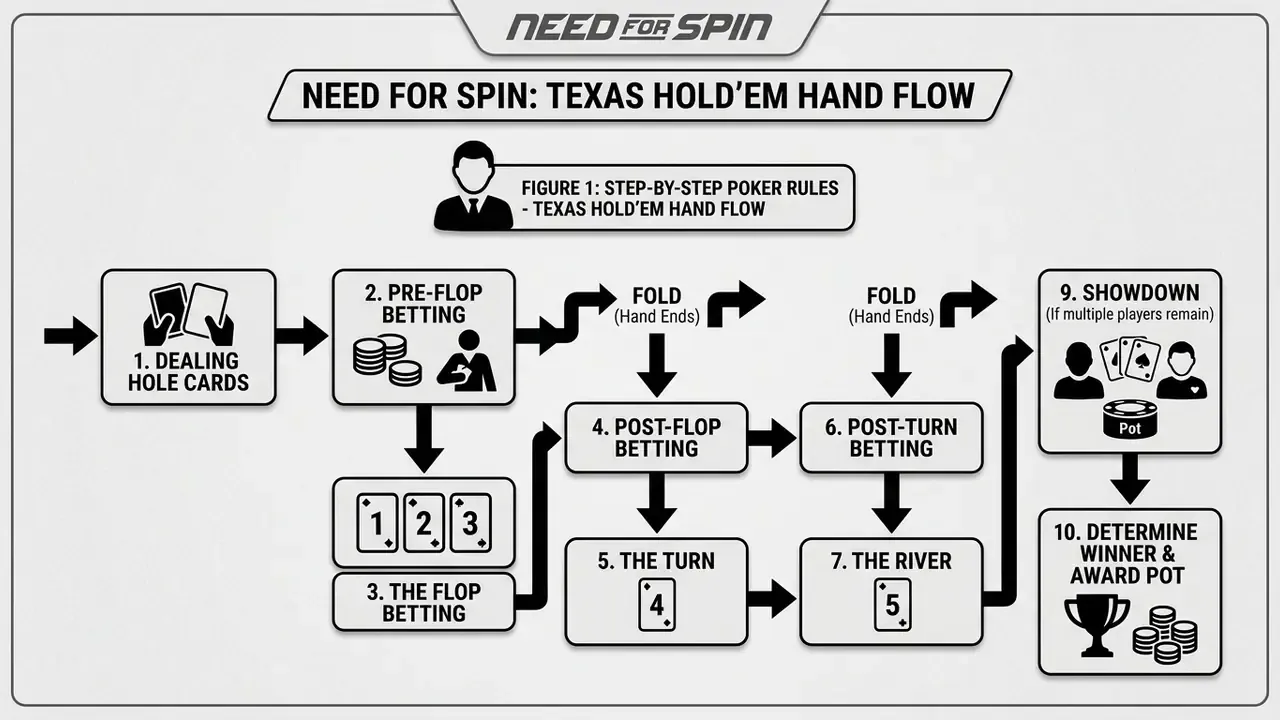
Basic poker rules are built on forming the highest five-card combination from the available cards and on placing bets across several betting rounds. In the most popular variant, Texas Hold’em, each player receives two face-down hole cards, after which five shared community cards are placed on the board in stages.
The winner of the hand is determined either at showdown or before it, if every other participant folds in response to a bet. Knowing the hand hierarchy and the order of action is a mandatory requirement for every format of poker play.

Step-by-step text transcript of the hand flow:
- Pre-flop: two hole cards are dealt, mandatory bets (blinds) are posted, and the first betting round runs clockwise starting from the player to the left of the big blind.
- Flop: three community cards are revealed, and the second betting round begins with the first active player to the left of the dealer button.
- Turn: the fourth community card is revealed, followed by a third betting round with a larger betting increment.
- River: the fifth and final community card is revealed, followed by the last betting round.
- Showdown: the remaining players compare their best five-card combinations and the pot is awarded to the winner.

Hand rankings and card values in poker
Classic poker uses a standard 52-card deck without jokers. All hand rankings are fixed by the mathematical probability of being dealt them out of the total of 2,598,960 possible five-card combinations.
Hierarchy of hands in ascending order of strength:
- High Card: no combination made; evaluated by the highest card (probability ~50.11%).
- One Pair: two cards of the same rank (probability ~42.25%).
- Two Pair: two cards of one rank plus two of another (probability ~4.75%).
- Three of a Kind / Set: three cards of the same rank (probability ~2.11%).
- Straight: five consecutive cards of any suit (probability ~0.39%). The Ace can play high (10-J-Q-K-A) or low (A-2-3-4-5).
- Flush: five cards of the same suit in any order (probability ~0.196%).
- Full House: three of a kind plus a pair (probability ~0.144%).
- Four of a Kind: four cards of the same rank (probability ~0.024%).
- Straight Flush: five consecutive cards of the same suit (probability ~0.00139%).
- Royal Flush: suited 10-J-Q-K-A, the strongest hand in poker (probability ~0.000154%, i.e. 4 combinations out of 2,598,960).
If several players at the table make the same category (for example Two Pair), the player with the higher cards inside the combination wins. When the matched ranks are identical, the kicker, the highest unpaired card in the hand, decides the pot. In Short Deck (6+) the same hierarchy applies with two exceptions noted above: a Straight beats Three of a Kind and a Flush beats a Full House.
One practical note from the tables. Beginners lose more money to misread kickers than to missed bluffs. A-9 against A-K on an ace-high board is not a pair you defend; it is a fold.

Betting, the dealer and actions at the poker table
At the poker table the dealer position is marked by a special chip, the button, which moves clockwise after every hand. The two players to the left of the button must post blind bets: the small blind and the big blind, which create the initial pot.
In each betting round a player has the following basic actions:
- Check:pass the action to the next player without adding chips to the pot (possible only when no bet has been made in the current round).
- Bet:the first wager in the current betting round.
- Call:match the current largest bet at the table.
- Raise:increase the current bet, forcing opponents either to pay more or to fold.
- Fold:discard your cards and give up any claim to the current pot.

The right of first action pre-flop belongs to the player seated to the left of the big blind (the Under the Gun position). On every subsequent street (flop, turn, river) the betting is opened by the first active player to the left of the button.
Poker demo and poker real money: what’s the difference
The main difference between poker demo and poker real money lies in financial risk, the type of currency used and the psychological pressure on the player. In demo mode you play with virtual chips (play money), whereas real-money mode requires a deposit and carries the risk of directly losing your own funds.
Research into player behaviour shows that demo mode works as an effective training ground for absorbing the mechanics of the game, but also that simulated gambling is statistically linked to later harm:
«A study of 1,026 young adults (18–25) found that participation in most simulated gambling products was associated with higher harm from real-money gambling.» - Browne et al., Journal of Gambling Studies / Australian Gambling Research Centre (2023). https://link.springer.com/journal/10899
The transition to real stakes substantially changes both the behaviour of your opponents and the stress level at the table.
Information here is general in nature and does not replace professional advice. Real-money play carries a risk of financial loss.
Alert Box: Playing for real money ⚠️ Financial risk and responsibility: playing poker for real money involves the risk of losing funds. Never gamble money set aside for essential living costs (housing, food, medical expenses). Set deposit and session limits before you start playing. Poker is entertainment, not a guaranteed source of income. (19+; 18+ in Alberta, Manitoba and Quebec)
Why start with poker demo
Poker demo mode is designed for safe familiarisation with the software interface, the rules of a specific discipline and the speed of decision-making. It is available without making a real deposit.
The main tasks demo mode solves:
- Learning the betting mechanics, the control buttons and the client’s time-bank behaviour.
- Practically verifying hand rankings and the rules of pot calculation.
- Initial practice of basic concepts without risking your own capital.
At the same time, experts warn: winning with virtual chips does not guarantee comparable results at real-money tables, because opponents in demo versions frequently make reckless plays precisely because the chips have no value. There is also a documented behavioural risk in treating simulated products as harmless:

«Adolescents aged 16–17 who played simulated gambling games were 40 percentage points more likely to spend real money on gambling at ages 18–19.» - Australian Gambling Research Centre, literature review on the classification of computer games (2023). https://www.agrc.org.au
This information is general in nature and does not replace consultation with a responsible-gambling specialist. If you notice signs of dependence, contact a player support helpline (in Ontario: ConnexOntario, 1-866-531-2600).
What changes in real money poker
When you move into real money poker, every decision has a monetary equivalent, which activates psychological pressure and the phenomenon known as “tilt”, an emotional breakdown that pushes a player away from optimal strategy.
The opponent pool in real money poker is qualitatively different from demo tables: here you meet disciplined players who account for mathematical expectation and positional advantage. Tilt itself has been measured psychometrically:
«A validated OPTS scale (263 online poker players, mean age 26.7) identified two dimensions of tilt, emotional-behavioural and cognitive, both associated with deviation from optimal strategy.» - Online Poker Tilt Scale (OPTS), Academia.edu, re-uploaded 2024. https://www.academia.edu
In practice, both dimensions are most often triggered by losing streaks (bad beats) and by ignoring bankroll-management rules.
In our own expert practice we observed a case where a player, after a run of success in free software, jumped straight to $1/$2 tables without preparation. A lack of bankroll discipline and unpreparedness for tilt led to losing the starting stack in 15 minutes. Fifteen minutes. After adopting a rule of “a minimum of 30 buy-ins for the limit” and dropping to micro-stakes at $0.02/$0.05, the same player stabilised results over a sample of 10,000 hands.
How to choose poker sites for online play
Choosing a reliable poker site requires assessing licensing, traffic volume, software quality and the availability of payment methods. Licensed operators keep client funds in segregated accounts and guarantee the integrity of the RNG. If you want a starting point, compare shortlists of licensed iGaming platforms before you register anywhere.
For a Canadian audience the key factors are support for CAD settlements and the availability of convenient local payment systems such as Interac and popular e-wallets.
Alert Box: Legality and age limits in Canada 🇨🇦 Legal status: online poker is legal across Canada, but regulation depends on the province. In Ontario the market is licensed by iGaming Ontario in partnership with the Alcohol and Gaming Commission of Ontario (AGCO). Players in other provinces typically use offshore-licensed rooms (Kahnawake Gaming Commission, Malta Gaming Authority, Curaçao), which is not prohibited for the individual player. 🔞 Age limit: the minimum age is 19 in most provinces. Exceptions: in Alberta, Manitoba and Quebec real-money play is permitted from 18. 🧾 Practical note: an Ontario-licensed operator must display its iGO/AGCO registration; an offshore room should display its licence number and dispute-resolution contact. If neither is visible, treat it as a red flag.
Games, player traffic and table selection
Liquidity and player traffic are critical parameters when picking a platform. If a site has low attendance, you will face missing limits and long waits for tournament tables to fill.
According to analytics from Primedope (2026) and PokerScout, the large poker rooms distribute traffic roughly as follows:
- GGPoker:the outright leader in liquidity (11,000+ peak cash-game traffic, weekly averages above 11,500 active players per Worldpokerdeals, 2026), with a broad selection of micro and high limits.
- PokerStars:steady presence in the top three (~2,000–3,000 cash players), with a rich selection of mixed games (Stud, Omaha, Hi/Lo variants).
- WPT Global:a fast-growing network (~2,200 average traffic) oriented toward a recreational pool.

«Per Primedope (2026), GGPoker has overtaken PokerStars in cash-game traffic across most time zones; the methodology uses six daily measurements with emphasis on off-peak hours.» - Primedope, Largest Poker Sites by Player Traffic (2026). https://www.primedope.com
The global picture matters as much as any single room:
«The global market peaked at around 32,000 concurrent cash players in early 2024, then stabilised at 22,000–24,000 by mid-2025.» - Rakerace, online poker traffic analysis 2022–2025 (2025). https://rakerace.com
Note also that “stable traffic” at legacy brands deserves a caveat:
«Rakerace records a decline in PokerStars concurrent cash players from roughly 4,000–4,500 in 2022 to about 2,000 by mid-2025.» - Rakerace, online poker traffic analysis 2022–2025 (2025). https://rakerace.com
High traffic lets you find “soft” tables with a large share of weak players (high VPIP) at any hour of the day. For a Canadian on Pacific time that matters twice over, since the European peak lands in your morning and the North American peak in your evening.
Comparative analysis of leading poker rooms (2026)
Bonus size alone tells you nothing without rakeback, network and payout speed. The table below compares the platforms most relevant to Canadian and international players. Terms are checked as of Q1 2026 and may change; always re-read the current T&C in the cashier.
| Poker room | Welcome bonus | Typical rakeback | Available disciplines | Payout notes |
|---|---|---|---|---|
| GGPoker | 100% up to $600, or $100 in tickets | Up to 60% (Fish Buffet) | Hold’em, PLO, Short Deck, Rush & Cash | 1–3 days; Interac / e-wallets |
| CoinPoker | 150% up to $2,000 + $50 bonus | Up to 33% (CoinRewards) | Hold’em, PLO4/PLO5/PLO6, Short Deck | Fast crypto cash-outs (1–2 hours) |
| ACR Poker | 100% up to $2,000 | 27% flat, or VIP rewards | Hold’em, Omaha, PLO5, Stud, 7-Card | Cards supported, BTC/USDT |
| 888poker | $20 no-deposit + 100% up to $400 | Up to 10% (club rewards) | Hold’em, Snap (fast-fold), BLAST | Interac, Visa/Mastercard, PayPal |
Read the table as a trade-off map: the biggest headline bonus (CoinPoker) is paired with limited fiat rails, the highest rakeback ceiling (GGPoker) requires volume to unlock, the flat 27% (ACR) is simplest to calculate, and the no-deposit route (888poker) is the cheapest way to test software before funding an account.
Payout methods and realistic cash-out speeds in Canada
For most Canadian players the deciding factor is not the bonus, but how quickly CAD leaves the cashier and lands in an account. The figures below reflect commonly published operator processing windows plus banking time.
| Method | Deposit | Withdrawal window | Typical CAD limits | Fees |
|---|---|---|---|---|
| Interac e-Transfer | Yes | 2–24 hours (often same day) | C$10–C$5,000 per transaction | Usually none from the room; bank fees possible |
| iDebit / Instadebit | Yes | 24–48 hours | C$10–C$3,000 | Small fixed fee at some rooms |
| MuchBetter / Skrill / Neteller | Yes | 1–12 hours after approval | C$10–C$10,000 | 0–2.5% depending on wallet |
| Visa / Mastercard | Yes | 2–5 business days | C$20–C$2,500 | Possible cash-advance fee from issuer |
| Crypto (BTC, USDT, ETH) | Yes | 1–2 hours (network-dependent) | Equivalent of C$20–C$50,000 | Network fee only |
Two practical rules: complete KYC before requesting your first withdrawal, because verification, not the payment rail, is what usually causes delays; and withdraw using the same method you deposited with wherever the room’s policy requires it.
Software, mobile and payment methods
Quality software must run without lag during multi-table play. Mobile clients for iOS and Android should fully duplicate desktop functionality, including access to the cashier and security settings. In terms of payments, poker sites should support fast deposits and withdrawals in the currency you actually hold.
A small thing that reveals a lot: open the mobile cashier before you deposit. If withdrawal options are missing on mobile and only appear on desktop, that is worth knowing in advance, not at the moment you want your money.
Modern features of poker clients worth checking
- Run It Twice (RIT):when players are all-in before the river, the remaining community cards are dealt twice and the pot is split into two halves. This reduces the impact of one-off bad beats without changing long-term expectation.
- Straddle:a voluntary blind bet of 2 BB posted by the UTG player before the cards are dealt. It moves the last pre-flop action to the straddler and effectively doubles the stakes of the hand.
- Fast-Fold Poker (Zone Poker / Rush & Cash / Snap):pressing “Fold” instantly moves you to a new table and a new hand, allowing 250–300 hands per hour on a single table. Bovada launched Zone Poker in August 2013, making it the first fast-fold product on a US-facing site.
- Anonymous tables:player names are hidden, which limits third-party HUD tracking and levels the field for recreational players.
- Bomb pots and jackpot formats:pre-flop forced-ante hands and progressive bad-beat jackpots that can exceed $30,000, useful for entertainment value but irrelevant to expected value.

[❓ КВИЗ: 4 checks to run on a poker site before registering]
- Is there a named licence (iGaming Ontario/AGCO, MGA, Kahnawake)? -> Yes/No
- Are CAD withdrawals supported via Interac / e-wallets without hidden fees? -> Yes/No
- Is there enough traffic at your working limits (NL10, NL50, etc.)? -> Yes/No
- Are responsible-gambling tools available (deposit and loss limits)? -> Yes/No Result: if even one answer is "No", we recommend considering another platform.
Fact Check: verifying platform terms Before making your first deposit, always verify the licence jurisdiction of the room, current withdrawal limits, bonus wagering rules and KYC requirements. Promotion terms and the list of available payment systems can be changed by the operator without prior notice.
Bonuses and value for playing poker online
The bonus system in online poker exists to attract new users and stimulate rake volume. Unlike standard casino bonuses, poker rewards are frequently released in instalments as you generate commission at the tables.
Regulatory research confirms how widespread promotions are, and how they are used:
«Nine in ten respondents had received a promotional offer in the previous four weeks; free spins were used ten times more often than other offer types.» - UK Gambling Commission, research into promotional offers and incentives, mixed-method study, June–September 2023. https://www.gamblingcommission.gov.uk
The same body of research found that around 76% of players engage with promotional offers in some form, which makes reading the accompanying T&C before activating any offer essential rather than optional.
Welcome bonus, deposit bonuses and additional rewards
A welcome package (welcome bonus) is most often tied to the first deposit (deposit bonus) and expressed as a percentage match of the amount (for example 100% up to $600).
The main bonus types:
- Instant Bonus:a small fixed amount in chips or tournament tickets, credited immediately after the deposit.
- Match Deposit Bonus:credited to a bonus account and released as real money in equal instalments (for example $5 for every $20 of rake generated).
- Reload Bonus:a reward for repeat deposits by existing players.
- No-deposit offers:a small balance or ticket bundle (for example $20 free) granted purely for registering and verifying an account.

In one of our reviews we came across an offer of a $500 bonus with a stated 40x wagering requirement on deposit plus bonus. A detailed audit of the T&C showed that fully clearing it would have required generating $20,000 in rake within 14 days, which is practically unachievable at micro-stakes. The lesson: always calculate the required rake volume before depositing funds. Treat the bonus as a contract, and the release schedule as its most important clause.
Freerolls, tournament tickets and rakeback
- Freerolls:tournaments with free entry but a real prize pool. An excellent way to build a starting bankroll from zero.
- Tournament Tickets:free entries into specific tournament series, typically issued as part of welcome packages.
- Rakeback and VIP Rewards:a return of a percentage of paid commission. Depending on loyalty status, rakeback can range from 10% to 60%, and some networks add weekly leaderboards, splash pots or balance boosters during downswings.

For a low-volume recreational player, a flat rakeback percentage is usually worth more than a tiered scheme whose top tiers you will never reach. Do the arithmetic on the volume you actually play, not the volume the promo page imagines.
How to start playing poker online after choosing an offer
The process of starting to play poker online consists of several sequential steps that keep your account secure and your entry to the tables comfortable. For context on how mainstream real-money play has become:
«16% of adult Pennsylvania residents reported participating in online gambling in the past year, an increase over the 2021 and 2022 iterations.» - Pennsylvania Interactive Gaming Assessment, Online Gambling Report (2023). https://www.pgcb.pa.gov
Registration, choosing a table and your first poker game
To join a poker room and start playing, follow these steps:
- Create an account: complete the registration form with genuine data (name, address, date of birth to confirm you meet the 19+ or 18+ requirement for your province).
- Pass KYC: upload documents confirming identity and address (passport/ID and a utility bill).
- Install the client: download the official software for PC or mobile, or use an instant-play browser client where available.
- Choose a table: open the lobby and filter tables by discipline (Texas Hold’em), type (cash or tournament) and limits.
- Take a seat and buy in: pick an open seat, specify your buy-in amount and confirm.

Step-by-step: moving safely from demo to real money
To move from demo mode to real-money play without unnecessary damage, follow an algorithm of gradually increasing responsibility:
- Log a sample in demo first. Play at least a few hundred hands to internalise the interface, the time bank and pot calculation, not to “prove” you can win.
- Set limits before funding. Configure deposit, loss and session limits in the cashier while you are still calm and unbiased.
- Deposit the minimum viable amount through a reliable payment system (Interac e-Transfer or an e-wallet), never money earmarked for essentials.
- Start at the lowest available limits (micro-stakes: NL2, or tournaments at $0.50–$1.00).
- Limit yourself to 1–2 simultaneous tables to preserve concentration and decision quality.
- Record every session in a journal or tracking software: hands played, result, and how you felt at the end.
- Apply a bankroll gate for moving up: only change limits after 20–30 buy-ins are secured for the next level and results hold over a meaningful sample.
- Test the cash-out early. Withdraw a small amount within the first weeks to verify KYC, timelines and fees while the sums are still small.
That last step is the one most players skip. It is also the only one that answers the question “will they actually pay me?” before real money is at stake.

Poker strategy for beginners: how to play with discipline
A successful poker strategy is built on mathematical calculation, positional advantage and firm emotional control. Poker is a game of incomplete information, where the decisive factor is making decisions with positive expected value (+EV) over a long sample. It is worth dismantling one myth here:
«A study using the Iowa Gambling Task found that a group of online poker players did not outperform non-players in decision quality, showing higher BAS-Drive and physical anhedonia.» - Giustiniani et al., Addiction Biology (2024). https://onlinelibrary.wiley.com/journal/13691600
In other words, playing poker does not automatically make you a better decision-maker. Process and discipline do.
Fundamental strategy concepts for beginners:
- Starting hands chart: do not enter pots with weak holdings. Offsuit K-7, Q-8 or J-4 should be folded pre-flop. Focus on strong pairs (AA–TT) and suited broadway hands (AKs, AQs).
- Positional play: having the last word in a betting round is a major advantage. Play wider from the Button and Cutoff, and tighten your range in early positions (UTG).
- Bankroll management: your bankroll should hold a minimum of 20–30 full buy-ins for your chosen cash-game limit, and no fewer than 50–100 buy-ins for tournaments.
- Beating tilt: at the first signs of irritation or the urge to “win it back”, end the session immediately.
- Review your hands: analysing 10–20 marked hands after each session compounds faster than adding tables.

«A systematic review of 33 studies found that young men living alone and experiencing financial difficulty are at the greatest risk of online gambling disorder.» - Systematic review of risk factors for gambling disorder, Journal of Gambling Studies (2023). https://link.springer.com/journal/10899
This information is general in nature and does not replace consultation with a specialist. If gambling is causing harm, seek professional help.
Regular practice of the basics, review of played hands and adherence to responsible-gambling principles allow you to minimise risk and enjoy the game itself.
Frequently asked questions (FAQ)
How we evaluate poker platforms (methodology)
- Licence and jurisdiction:regulator name, registration number, dispute-resolution route.
- Sign-up and KYC:how long verification takes and which documents are demanded.
- Deposit and cash-out in CAD:testing Interac and e-wallet rails and timing the actual receipt of funds, not the operator’s claim.
- Traffic at usable stakes:table counts at NL2–NL50 and running MTT schedules at off-peak hours.
- Bonus mathematics:the rake volume genuinely required to release a bonus within its expiry window.
- Responsible-gambling tooling:deposit, loss and session limits, reality checks and self-exclusion.

Traffic figures cited above are cross-checked against independent trackers (Primedope, PokerScout, Rakerace) rather than operator marketing claims, and bonus terms are re-read in the cashier at the time of publication. Where something cannot be verified, it is marked as no data rather than guessed at.
Appendix A: corrections and source updates
For transparency, this version of the guide corrects several categories of issues found in the earlier draft:
- Age limits in Canada. The previous wording stated a single “19+” requirement. Updated wording: 19+ in most provinces, 18+ in Alberta, Manitoba and Quebec.
- Citation accuracy. The hands-per-hour figure previously attributed to the Journal of Gambling Studies (2023) has been re-attributed to a verified industry traffic analysis (Rakerace, 2023–2025). Similarly, the earlier general references to Browne et al. (2023), the International Journal of Mental Health and Addiction (2024) and the Online Poker Tilt Scale (2024) have been replaced with quotations that include sample sizes and methodology, so readers can judge the strength of the evidence themselves.
- Structure. The “demo to real money” transition, previously described in two separate places, is now consolidated into a single step-by-step algorithm in the onboarding section, while the heavy traffic statistics have been moved from the introduction to the traffic section where they are actionable.
- Payments. Withdrawal windows are now presented per method in CAD, with fees and limits, instead of a single blended “fast payouts” claim.

Responsible gambling disclaimer. This article is informational and does not constitute financial, legal or medical advice, nor a guarantee of winnings. Gambling involves the risk of financial loss and can be addictive. Play only with money you can afford to lose, set limits in advance, and never chase losses. Age restrictions apply (19+; 18+ in Alberta, Manitoba and Quebec). If you or someone you know has a gambling problem, contact a local support service, in Ontario, ConnexOntario at 1-866-531-2600.
Compare on the facts, read the terms before you deposit, and play responsibly.