Online Blackjack: Rules, Demo Games and Live Dealer Tables (Canada)

Last updated: 2026 · Written for Canadian players (19+, or 18+ in Alberta, Manitoba and Quebec)

"The review process is designed to test sign-up, deposit, game mechanics and cash-out before scoring. When evaluating online blackjack, understanding the rules, house edge and bonus terms matters far more than promotional slogans." Reid Calloway, Independent iGaming Analyst (editorial persona)

Online Blackjack Rules, Demo Games and

Three Things to Know Before You Play

  1. Rules first, money second. Blackjack beats the dealer by holding a total closer to 21 without busting. Learn card values, hit/stand/double/split and the dealer's Soft 17 rule in a free blackjack demo before you fund an account.
  2. Table rules decide your odds. A table that pays 3:2 on a natural and where the dealer stands on Soft 17 is materially cheaper to play than a 6:5 table. Insurance and side bets carry the worst mathematics on the felt.
  3. Format changes everything. RNG software reshuffles after every hand, so card counting is dead on arrival, while live dealer tables run a physical shoe. In Canada, check whether your operator is licensed through iGaming Ontario or sits offshore, and confirm Interac e-Transfer withdrawal timelines before depositing.
Three Things to Know Before You

What This Guide Covers

  • Blackjack rules, card values, hard versus soft hands and the full deal sequence
  • The standard payout structure (1:1, 3:2, 2:1) and the 6:5 trap
  • Insurance and side bet house edges, with numbers instead of adjectives
  • Basic strategy, quick rule-of-thumb decisions and Hi-Lo card counting
  • How to evaluate a blackjack casino: licensing, bonus contribution math, Interac payouts
  • FAQ: rigged RNG, counting cards online, dropped connections mid-hand

Blackjack remains one of the most accessible and mathematically balanced casino games available to Canadian players (19+). Whether you play through random-number-generator (RNG) software or a live video stream with a human dealer, the objective never changes: build a hand total closer to 21 than the dealer's total without going over.

Why does this matter before you deposit? Because the same game name can hide two very different price tags. Understanding how each online format operates, and how software rules differ from studio tables, is how you avoid the unpleasant surprises that show up only after the money has moved.

Blackjack remains one of the most

What Is Blackjack and How to Start Playing Online

📜 Origin trivia: why is it called "blackjack"? The game evolved from the French 21 ("Vingt-et-Un"), but the term blackjack gained traction during the American gold rushes. French card historian Thierry Depaulis has argued that the name borrows from "black-jack" (zinc blende), a mineral prospectors associated with rich silver and gold deposits. Frontier saloons paid a bonus when a player's two-card 21 contained the Ace of Spades next to a black Jack (spades or clubs). The bonus disappeared. The nickname did not.

Blackjack is a classic card game where you compete directly against the dealer's hand, not against the other players at the table. To start playing online you pick a licensed operator, choose between practice or real-money mode, and join a virtual or live table that fits your bankroll.

In modern online casinos, the blackjack game splits into two operational categories: RNG-based software and live dealer streams. In RNG blackjack online, certified algorithms decide card draws instantly. In live formats, physical cards leave a multi-deck shoe in the hands of a professional dealer, in real time, on camera.

Before you place a single CAD wager through Interac or an e-wallet, it pays to separate practice modes (free play) from funded play (blackjack real money). They teach different things.

Blackjack is a classic card game

Format Comparison: Demo, Free Play, Live and Real Money

Feature / CriteriaBlackjack DemoFree BlackjackBlackjack Live DealerBlackjack Real Money
Real money stakesNo (virtual credits)No (play chips)Yes (CAD wagers)Yes (CAD wagers)
Account registrationOften not requiredVaries by siteRequired (19+)Required (KYC verified)
Real human dealerNo (RNG engine)No (RNG engine)Yes (HD stream)Optional (RNG or live)
Risk of financial lossZeroZeroReal (subject to limits)Real (subject to limits)
Card counting viableNo (shuffle every hand)No (shuffle every hand)Possible (physical shoe)Depends on format
Typical round speedFast (instant deals)FastSlower (30 to 60 s per hand)Varies by format
Primary purposeRule testing and practiceCasual entertainmentAuthentic casino atmosphereFunded gameplay

In plain text, for anyone skimming on mobile: demo and free blackjack cost nothing and reshuffle constantly, live tables cost real CAD and run a real shoe, and real-money play may be either RNG or live depending on the lobby you open. Only the funded formats require full identity verification.

⚖️ Regulatory and compliance note Playing blackjack real money is restricted to adults who have reached the age of majority in their province (19+ in most, 18+ in Alberta, Manitoba and Quebec). Real-money gambling is chance-based entertainment, not an investment or an income strategy. Before depositing, confirm that the casino holds a valid licence recognised in your province (for example, an iGaming Ontario operating agreement where applicable) and read the bonus terms, withdrawal limits and wagering contribution rates for table games.

Blackjack Demo and Free Blackjack: Playing Without Stakes

A blackjack demo lets you experience the exact mechanics, interface and pacing of a digital table without exposing a dollar.

Because free blackjack runs on virtual credits, it mirrors the decision flow of software-based games precisely. Regulated RNG software uses independently tested algorithms so that card distribution stays random across every deal.

Independent testing of eight-deck blackjack software gives us a documented methodology rather than a vague fairness slogan. The audit sampled live production card data across a defined window and applied statistical distribution tests to the dealt outcomes.

Blackjack Demo and Free Blackjack Playing

«The audit covered 1–29 February 2024; statistical tests with reported p-values confirmed that the RNG is operating correctly.» iTech Labs, Blackjack Cards Analysis, February 2024 (Entain PLC technical audit report; no public URL).

In regulated iGaming, RNG outputs must be independently tested for randomness, unpredictability and uniform distribution before the software is certified for real-money release. One practical consequence follows from that: RNG blackjack normally reshuffles the virtual shoe after every hand, so the deck never depletes the way a physical shoe does.

Using free play is still the fastest way to memorise blackjack rules, test your decision logic and learn the table controls before you move to a real-money blackjack casino. Demo modes reproduce the decision mathematics accurately. What they cannot reproduce is the emotional cost of a losing streak. Because no bankroll is at stake, practice play cannot measure how consistently you will respect your own limits once real CAD is on the line. Treat a good demo session as evidence of decision accuracy, not as a forecast of profit.

One small observation from testing lobbies: demo tables often deal noticeably faster than the funded version of the same game. That speed feels productive. It also means you can burn through 200 hands of practice and learn almost nothing about pacing yourself.

In regulated iGaming, RNG outputs must

Live Blackjack with a Real Dealer

Live blackjack bridges digital convenience and physical table authenticity by streaming a human dealer from a dedicated studio straight to your screen.

In a blackjack live casino, the dealer blackjack setup uses a physical shoe (typically 6 to 8 decks), scans cards into the system through optical sensors, and lets players talk to the dealer through a live chat panel. Leading providers such as Evolution, Pragmatic Play Live and Playtech run multi-camera HD feeds with on-screen betting controls, seat selection, bet-behind options and optional side bets. Low-latency encoded video stays synchronised with game-state updates, so bets, dealing and round timing line up.

According to an industry evaluation summarised by Statista (2025) and cited in "The Impact of Live Dealer Games on the Casino Experience" (2025), the global live dealer sector was projected to reach USD 4.5 billion, pushed along by player demand for visual transparency and real-time interaction. Worth flagging: that figure is a secondary citation, reported by the analysis referencing Statista data rather than by a primary Statista page.

Live tables buy you atmosphere. They also cost you tempo. Pacing runs slower than RNG software, and minimum bet thresholds usually sit higher. Variants such as Infinite Blackjack and Speed Blackjack change seat availability and round tempo, but they do not change the underlying rules of the hand. If you want to play online blackjack cheaply while learning, RNG is the better classroom. If you want to read a real shoe, live is the only option.


Live Blackjack with a Real Dealer

Blackjack Rules: Game Objective, Cards and the Deal Sequence

The goal of blackjack is to beat the dealer's hand with a total closer to 21 without exceeding it. Go over, and you bust. That is the whole game in one sentence.

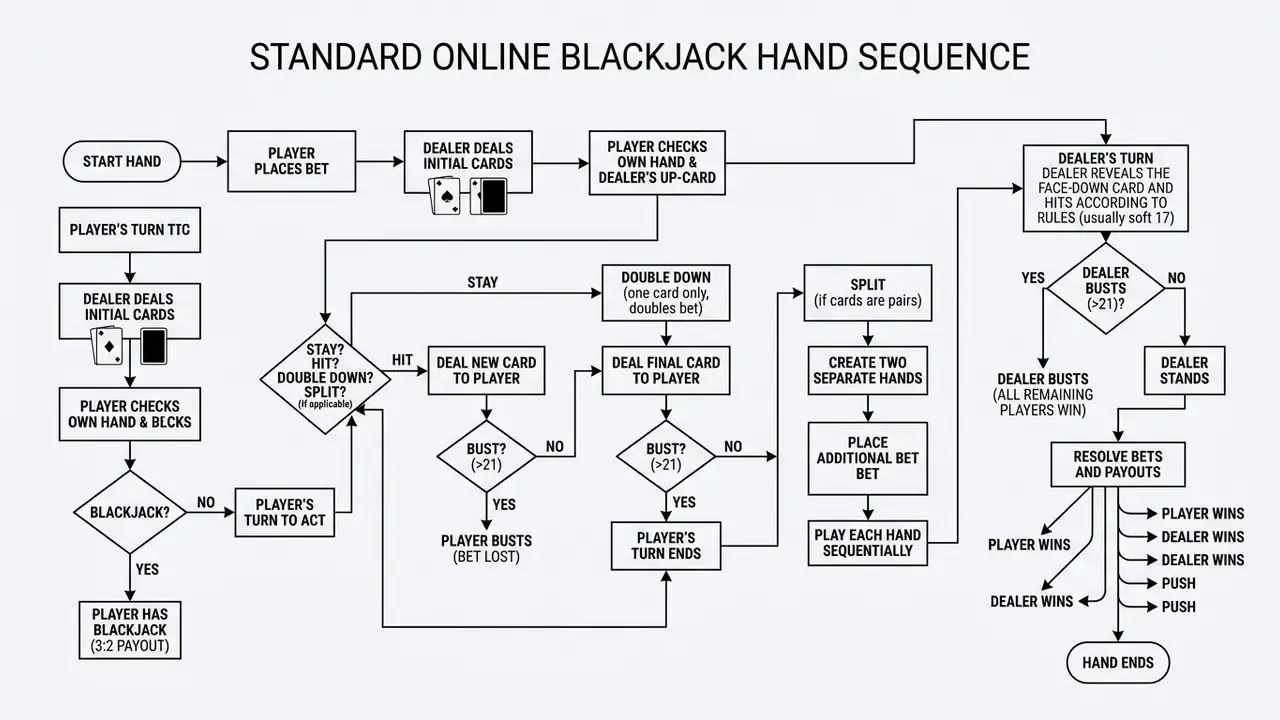
A standard round follows a fixed sequence: players place wagers, the dealer distributes two initial cards to each participant and two to themselves, hands are read, and players act in turn.

Critical Table Rules That Change the House Edge

Before you look at a single strategy chart, open the in-game information panel and confirm these five parameters. They separate a fair table from an expensive one:

Table RulePlayer-Friendly SettingCostly SettingPractical Effect
Blackjack payout3:26:56:5 adds roughly 1.39% to the house edge
Dealer on Soft 17Stands (S17)Hits (H17)S17 improves player expectation by about 0.2%
Deck count in shoe1 to 2 decks6 to 8 decksFewer decks slightly favour the player
Double after split (DAS)AllowedNot allowedDAS adds value to split hands
Late surrenderAllowedRemovedSurrender trims losses on Hard 15 and 16

[💬 CALLOUT: "Rule check: dealer Soft 17" - Always confirm whether the table requires the dealer to hit or stand on Soft 17. A table where the dealer stands on Soft 17 lowers the house edge by roughly 0.2% in the player's favour.]

Standard Blackjack Payout Structure

Outcome / Hand TypeWinning ConditionStandard Payout Ratio
Standard winHand total higher than dealer without exceeding 211:1 (even money)
Natural blackjackAce plus a 10-value card on the initial two cards3:2 (a $10 bet pays $15)
Dealer bustDealer total exceeds 211:1
Push (tie)Player total equals dealer totalStake returned
Loss / bustPlayer exceeds 21, or dealer holds the higher valid totalStake forfeited
Insurance side betDealer shows an Ace and holds a hidden 10-value card2:1 (costs 0.5x the main bet)

⚠️ Payout variations: be wary of tables offering 6:5 on a natural. That single change raises the house edge by roughly 1.39% compared with a standard 3:2 table, which is more than accurate basic strategy can win back.

Card Values and the Blackjack Hand

Reading card values quickly is the base skill. Everything else sits on top of it:
  • Cards 2 through 10:face value.
  • Jacks, Queens and Kings:10 points each.
  • Ace:flexible, worth either 1 or 11, whichever helps the total more.
Card Values and the Blackjack Hand

How a total is classified then dictates your play:

  • Soft hand: contains an Ace counted as 11 (Ace + 6 = Soft 17). A soft hand cannot bust on a single draw, because the Ace drops back to 1 if the total passes 21.
  • Hard hand: no Ace, or an Ace that must count as 1 (10 + 6 = Hard 16, and Ace + 6 + 9 = Hard 16 as well).

That distinction trips up more beginners than any chart. Soft 18 and Hard 18 look identical on the felt and play very differently.

The Deal Sequence Step by Step

Step-by-step progression of a blackjack round from initial bet to payout resolution
  1. Betting phase: players place the initial bet with virtual chips before any card is drawn.
  2. Initial deal: the dealer gives two cards to each player, face up, and two to themselves (usually one face up, one face down, the "hole" card).
  3. Natural check: hands are checked for a two-card 21. Naturals are paid immediately, typically at 3:2.
  4. Player decisions: each player acts individually, left to right, choosing to hit, stand, double down or split.
  5. Dealer turn: once all players have finished, the dealer exposes the hole card and draws by fixed table rule, commonly hitting on 16 or less and standing on 17 or more.
  6. Settlement: final totals are compared against the dealer's hand. Winners are paid, ties push and stakes come back, and if the dealer busts every surviving hand wins.
1. Betting phase players place the

Hit, Stand, Double and Split: Player Decisions

Once the cards are out, you choose from four core actions based on your total and the dealer's up-card:
  • Hit:take another card. You may keep hitting until you stand or bust.
  • Stand:freeze your total and end your turn.
  • Double down:double the original wager, take exactly one card, then stand automatically.
  • Split:with a pair (8-8, K-K), separate the cards into two hands by matching your original wager.
Hit, Stand, Double and Split Player

🔍 Fact check: rule variations across tables Never assume every online table uses the same parameters. A game-theory analysis of blackjack variants published in arXiv (2024) showed that small rule tweaks, such as moving the payout from 3:2 to 6:5, limiting doubles to 9/10/11, or removing late surrender, shift optimal decision points and widen the operator's edge.

«In simplified blackjack variants the optimal policy is to hit on hard 2–14 and stand on 15–20; small rule changes shift these decision thresholds.» Basic Strategy for Some Simplified Blackjack Variants, arXiv preprint (2024).

Open the in-game help menu and confirm the rules before you stake real money. It takes fifteen seconds.

Insurance and Side Bets: Where the House Edge Spikes

Insurance is an optional side bet offered only when the dealer's face-up card is an Ace. You stake half your original wager, and it pays 2:1 if the hole card is worth 10. It settles separately from your main hand.

The mathematics are unfriendly. In a multi-deck shoe the dealer completes blackjack under an Ace only about 30.7% of the time, so a 2:1 return is priced below fair value. It looks like protection. It is a second bet with a worse edge than the first.

Side BetTypical Payout RangeApproximate House EdgeVerdict
Insurance2:1~7.4%Decline unless you are counting a very positive shoe
Perfect Pairs6:1 to 30:1~4% to 11%Entertainment only
21+35:1 to 100:1~3% to 8%Entertainment only
Any Pair / Bust ItVaries widely~5% to 10%Highest variance, lowest expectation

⚠️ Bankroll warning: every dollar routed into a side bet meets a house edge 6 to 20 times larger than on the main blackjack wager. If side bets are part of your fun, cap them at a small fixed share of the session budget and count them as entertainment spend.

Blackjack Strategy: A Basic Approach to Bets and Decisions

Applying a basic blackjack strategy means deciding by calculated expectation rather than instinct. No mystique, just a table of best answers.

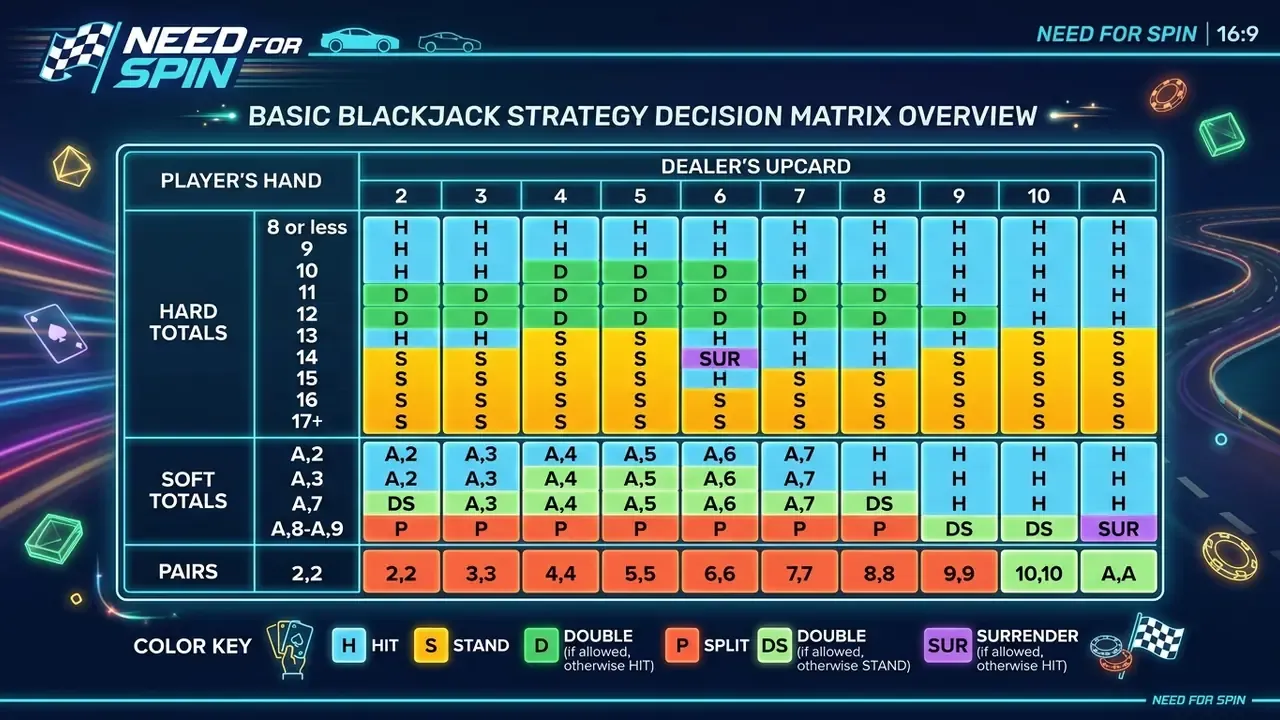
Basic strategy is a decision matrix: for every combination of your hand and the dealer's up-card, it names the optimal action (hit, stand, double or split).

[💬 CALLOUT: "Golden rules of thumb for instant play"]
  • Never split 10s, 5s or 4s. A pair of 10s is already a winning 20; a pair of 5s is a Hard 10 and a double-down candidate.
  • Always split Aces and 8s. Splitting Aces buys two shots at 21; splitting 8s dismantles a hopeless Hard 16.
  • Hit Hard 8 or lower. No single card can bust you, so there is nothing to protect.
  • Double on 10 or 11. These totals turn one card into a strong hand more often than any other start.
  • Never stand on Hard 12 to 16 against a dealer 7 through Ace. You have to improve, because the dealer will usually land on 17 to 21.
  • Never take insurance. A 10-value hole card sits under that Ace only about 30.7% of the time, which prices insurance at roughly a 7.4% house edge.
Blackjack Strategy A Basic Approach to
Standard basic strategy recommendations based on player hand vs dealer up-card

Text Fallback: Core Decision Grid (6 to 8 decks, dealer stands on Soft 17)

Your HandDealer 2–3Dealer 4–6Dealer 7–9Dealer 10–Ace
Hard 8 or lessHitHitHitHit
Hard 9HitDoubleHitHit
Hard 10–11DoubleDoubleDoubleHit (11: double vs 10)
Hard 12HitStandHitHit
Hard 13–16StandStandHitHit
Hard 17+StandStandStandStand
Soft 13–17 (A2–A6)HitDoubleHitHit
Soft 18 (A7)StandDoubleStand vs 7–8, hit vs 9Hit
Soft 19+StandStandStandStand
A-A / 8-8SplitSplitSplitSplit
10-10 / 5-5 / 4-4Never splitNever splitNever splitNever split

Core Principles Behind the Grid

  1. Weak dealer (2 through 6): the dealer busts more often, so you stand on hard totals of 12 or higher and let them break.
  2. Strong dealer (7 through Ace): the dealer is likely to finish on 17 to 21, so you hit until you reach at least 17.
  3. Always split Aces and Eights: two live hands beat one bad one.
  4. Never split Tens: a starting 20 already wins the overwhelming majority of rounds.

Mathematical Foundations and Bankroll Management

Under favourable rules, 3:2 naturals, dealer standing on Soft 17, double after split allowed and late surrender available, accurate basic strategy is generally documented as compressing the house edge to roughly 0.5% or less. Weaker rule sets drag it toward 1.5% to 2%. That range depends entirely on the parameters at your table, so treat it as a rule-dependent estimate rather than a fixed promise, and verify the details in the help panel.

«A curriculum-trained deep Q-network agent raised the average win rate from 43.97% to 47.41% and cut bust frequency from 32.9% to 28.0%, accelerating learning by more than 74%.» Learning to Play Blackjack: A Curriculum…, arXiv preprint (2026). https://arxiv.org

Note what that number implies. Even a well-drilled optimal agent still wins under half of its hands. Basic strategy narrows the gap; it never closes it. A dynamic betting study from arXiv (2025) made the same point from the money side: long-term survival depends on bankroll discipline, not on decision accuracy alone.

  • Fixed bet sizing:keep each bet to 1% or 2% of the session bankroll so ordinary variance cannot wipe you out. Professional models tie stake size to risk of ruin for exactly this reason.
  • Avoid chasing:behavioural tracking research on real online gambling accounts found measurable win-chasing, and it did not find blackjack safer than slots on loss chasing. > «Players returned to betting faster after large wins; the intensity of between-session loss chasing in blackjack was not statistically different from slots.» Between-session chasing of losses and wins in an online…, U.S. National Library of Medicine (2024). https://pubmed.ncbi.nlm.nih.gov
  • Session limits before play:set deposit, loss and time limits in the account dashboard before the first hand. Not mid-streak, when judgement is worst.
  • Entertainment first:no system, Martingale included, and no counting software can guarantee profit over time.
Need For Spin heading-banner

Disclaimer: this information is general and does not replace advice from a qualified specialist. Real-money gambling carries a risk of financial loss. If controlling your play is becoming difficult, contact a problem-gambling helpline in your province, for example ConnexOntario or the responsible-gambling service listed by your regulator.

Card Counting Basics: The Hi-Lo Method

Counting tracks the ratio of high cards to low cards left in the shoe. It is useless in RNG software, which reshuffles the virtual shoe after every deal, but it can apply to live dealer streams dealt from a physical shoe.

  1. Assign tag values:
    • 2 through 6 = +1 (losing low cards helps the player)
    • 7 through 9 = 0 (neutral)
    • 10, J, Q, K, Ace = −1 (losing high cards helps the dealer)
  2. Keep the running count: start at zero on a fresh shuffle, then add or subtract the tag of every card you see.
  3. Convert to a true count: True Count = Running Count ÷ Decks Remaining.
  4. Adjust bet sizing: a true count of +2 or higher signals a richer supply of 10s and Aces, which means more naturals and more profitable doubles. Scale up modestly, and drop back to the table minimum when the count turns negative.
Card Counting Basics The Hi-Lo Method

⚠️ Reality check for online play: many live tables run continuous shuffling machines, shallow penetration or pre-shuffled shoes, all of which erase countable information. Operators also monitor betting patterns, and advantage play can trigger table or account restrictions under their terms of service. Treat Hi-Lo as a way to understand deck composition, not as an income plan.

Blackjack Casino: How to Evaluate Offers, Bonuses and Format

You know the rules and the maths. Now the harder question: where do you play? Evaluating a blackjack casino means checking licensing credentials, the range of blackjack games, payment reliability and the fine print of promotions before you create an account.

Plenty of online casinos advertise generous welcome offers. Table games such as blackjack usually contribute far less to wagering than slots do, and that single line in the terms decides whether the offer is worth anything to you.

Checklist: Evaluating an Online Blackjack Offer

[❓ CHECKLIST: Pre-deposit checklist for Canadian blackjack players]
  • Licensing and safety: a verified licence from a recognised authority (iGaming Ontario / AGCO, a provincial lottery corporation, or equivalent oversight).
  • Practice mode: a free blackjack demo so you can test software speed and layout before funding.
  • Bonus contribution: terms that state the exact contribution rate for table games, typically 5% to 10%.
  • Table limits: a spread of minimum and maximum bet levels that suits both cautious and larger bankrolls.
  • Payment methods: support for Canadian rails, Interac e-Transfer, e-wallets, credit and debit.
  • Live studio quality: HD streams from established providers (Evolution, Pragmatic Play, Playtech) with clean dealer audio.
  • Responsible gambling tools: deposit, loss and session limits you can set yourself from the dashboard.
  • Payout transparency: published processing times, a clear KYC document list and any monthly cash-out cap.
  • Rule disclosure: the payout ratio (3:2 or 6:5) and the Soft 17 rule visible in the help panel before you stake.
Checklist Evaluating an Online Blackjack Offer

The Bonus Contribution Trap: A Worked Example

Headline numbers rarely survive contact with the contribution table. Here is the arithmetic that turns an attractive offer into an unrealistic target:

Bonus ScenarioWagering RequirementBlackjack ContributionActual Turnover Needed
$100 bonus30x bonus100% (slots)$3,000
$100 bonus30x bonus10% (blackjack)$30,000
$100 bonus30x bonus5% (blackjack)$60,000
$100 bonus30x (deposit + bonus)10% (blackjack)$60,000

At a $10 average bet, $30,000 of turnover means 3,000 hands. Dozens of hours, all of it exposed to the house edge, and all of it governed by maximum-bet clauses that can void the bonus if you cross them once by accident. For many blackjack players the cleaner decision is simple: decline the bonus, play with cash, keep withdrawals unrestricted.

Research also suggests headline promo value moves behaviour less than operators assume:

«Cutting weekly free-play from $15 to $5–10 did not change spend per visit; only full removal of the offer reduced visitation by roughly 20%.» Measuring the Impact of Reduced Free-play Offers on Casino Loyalty Behavior, UNLV Gaming Research & Review Journal (April 2024). https://digitalscholarship.unlv.edu

Canadian Payments: Interac and Withdrawal Timelines

MethodTypical Min. Deposit (CAD)Withdrawal ProcessingNotes
Interac e-Transfer$10 to $201 to 3 business days after approvalThe most common CAD channel; bank-linked, no card data shared
iDebit / Instadebit$101 to 3 business daysBank-to-casino rail, small transfer fees possible
MuchBetter$10Hours up to 24 hMobile wallet; the fastest tier at many operators
ecoPayz / Skrill / Neteller$10 to $20Hours up to 24 hFrequently excluded from welcome bonuses
Visa / Mastercard$10 to $203 to 5 business daysSome Canadian issuers decline gambling transactions
Crypto (where offered)VariesUnder 1 h up to 24 hOffshore only; outside provincial oversight

Every timeline above starts after internal approval and KYC clearance, which is the part players forget. Expect an identity check on your first withdrawal (government ID, proof of address, proof that the payment method belongs to you) and budget 24 to 72 hours for that review.

Ontario Versus the Rest of Canada

  • Ontario (19+): commercial operators must be registered with the AGCO and hold an operating agreement with iGaming Ontario. That gives players provincial dispute channels, mandated responsible-gambling tools and local advertising rules.
  • British Columbia, Quebec, Manitoba, Alberta, Saskatchewan and Atlantic Canada: provincial products run through Crown corporations, such as BCLC's PlayNow, Loto-Québec's Espacejeux and PlayAlberta. Offshore sites stay accessible in practice, but they sit outside provincial consumer protection, so complaint resolution depends entirely on the foreign licensing body.
  • Age of majority: 19+ in Ontario, BC, Saskatchewan, Nova Scotia, New Brunswick, Newfoundland and Labrador and PEI; 18+ in Alberta, Manitoba and Quebec.

Our editorial framework scores an operator only after a reviewer has walked the whole path personally: registration, KYC upload, a live deposit, at least one RNG and one live blackjack session, then a real cash-out request timed to the minute. Bonus fine print, table-rule disclosure (3:2 versus 6:5) and withdrawal speed are logged as separate, comparable data points instead of being blended into a single star rating. For a full breakdown of how that testing sequence is built, see the iGaming review guide.

Ontario Versus the Rest of Canada

Common Beginner Mistakes at the Online Table

A short list, drawn from the errors that cost the most per hand:

  • Opening a table without reading the rules panel. You cannot price a game you have not checked. The 6:5 payout hides in plain sight.
  • Treating insurance as safety. It is a separate wager with a roughly 7.4% edge against you.
  • Raising the stake after a loss. Variance has no memory, but your bankroll does.
  • Claiming a bonus for table play by reflex. With 5% to 10% contribution, the requirement often outlives your deposit.
  • Skipping KYC until the first withdrawal. Upload documents early and the payout clock starts sooner.
Common Beginner Mistakes at the Online

FAQ: Online Blackjack Questions Canadian Players Ask

Summary Verdict

Online blackjack pairs simple rules with one of the lowest house edges on the casino floor, provided you play accurate basic strategy at a fair table. Beginners should use blackjack demo modes to drill hit, stand, double and split decisions at zero risk before moving to live dealer blackjack or funding an account in CAD.

Then check four things, every time. Confirm the payout ratio, 3:2 and never 6:5, along with the Soft 17 rule. Decline insurance and side bets by default. Calculate the real turnover behind any bonus before you opt in. Verify your operator's licensing status for your province.

Compare on the facts, read the terms line by line before you deposit, and treat every session as paid entertainment with a fixed budget.

Summary Verdict. Online blackjack pairs simple

🛟 Responsible gambling notice (19+) This guide is informational and is not financial, legal or gambling advice. Real-money blackjack involves the risk of losing your stake, and no strategy or counting system guarantees a profit. Play is restricted to those who have reached the age of majority in their province (19+ in Ontario, BC, Saskatchewan and Atlantic Canada; 18+ in Alberta, Manitoba and Quebec). If gambling is affecting you or someone close to you, contact your provincial support service, for example ConnexOntario (1-866-531-2600), or the responsible-gambling resources listed by your regulator. Know your limit, play within it.