Aviator: How to Play Online, Demo Mode, and Real Money Bets

Aviator is a social multiplayer crash game built by Spribe in 2019. A rising multiplier climbs alongside a small virtual plane until the plane vanishes at a randomly generated point. To play Aviator online with any sort of discipline, you place a stake before the round starts, then press cash out before the aircraft flies off the screen. That's the whole loop. Simple to learn, and easy to overspend on, which is exactly why the details below matter.

«Crash games look simple on the surface, but understanding the fine print, from the 97% RTP to exact cash-out timing, is what keeps entertainment from becoming a financial headache.» — Reid Calloway, Independent Online-Casino Analyst (fictional editorial persona)

Whether you plan to test the mechanics through an aviator demo or wager CAD at a licensed Canadian online casino, the mathematical parameters and the cryptographic verification tools deserve a look before your first bet lands.


Aviator How to Play Online, Demo

Why This Guide Matters Before You Deposit

Most Aviator pages online do one of two things: they sell you a "predictor," or they promise a strategy that beats the game. Neither survives contact with the math. What follows is the plain-English version: how a round is generated, what the odds actually are at each cash-out target, why crash games are the most commonly excluded category in bonus terms, and which four checks belong on your list before money leaves your bank account.

One more thing worth saying up front. Aviator moves fast, roughly 60 to 90 rounds an hour. Speed is the real risk here, not the 3% house edge.

What Is Aviator and How the Crash Game Works

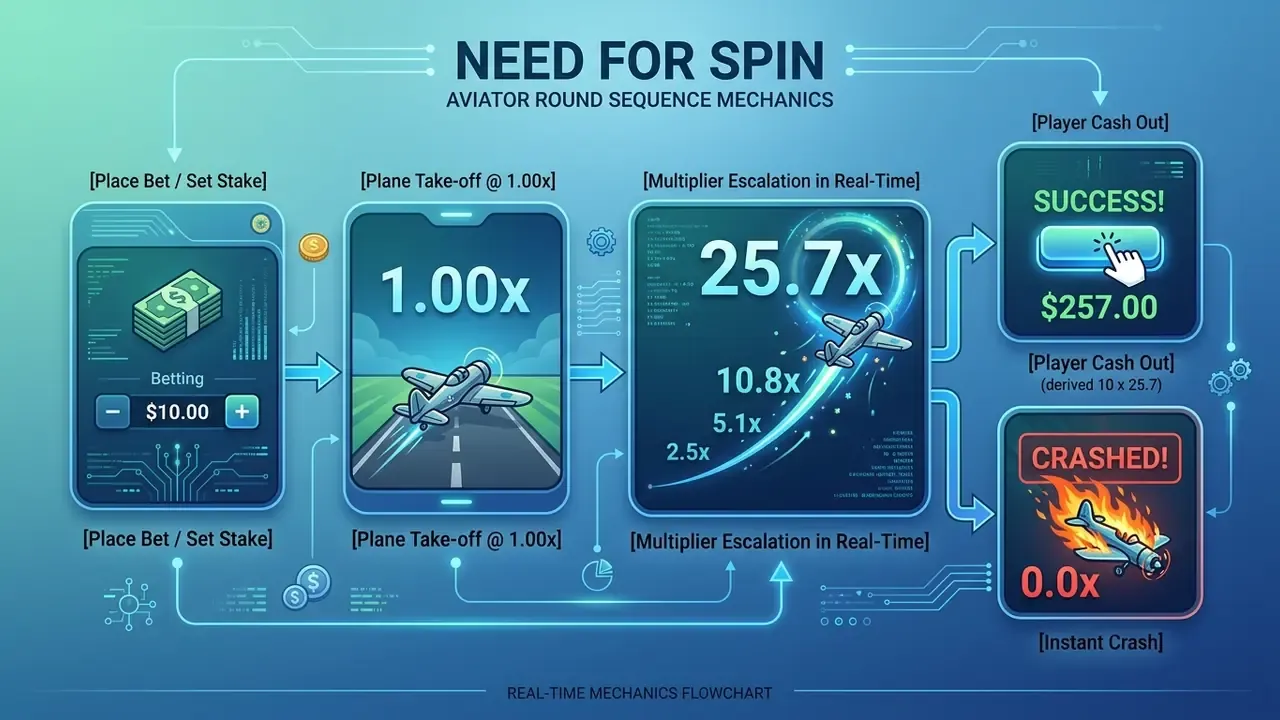
Aviator is an online crash-style wagering game developed by Spribe in 2019. It replaces traditional slot reels with a curve-based multiplier mechanic. Every round begins with an on-screen plane taking off at a baseline multiplier of 1.00x, which then increases continuously in real time until a cryptographically pre-determined crash point ends the round instantly.

aviator game round flow diagram illustrating real-time cash out vs crash events
Step-by-step event progression of an Aviator crash round from stake placement to settlement

In an aviator game round, your only job is to cash out manually, or let an automated threshold do it for you, before the plane leaves the screen. Cash out in time and your stake is multiplied by the coefficient showing at that moment. Miss it, and the entire stake for that round is gone.

Spribe built Aviator as a shared multiplayer environment. Every active player sees the same rising coefficient, the same live participant list, the same cash-out points, all at once. Rounds are short, typically 8 to 30 seconds including the pre-round betting pause, which produces roughly 60 to 90 rounds per hour on a normal connection. Technical vendor documentation supplied by Spribe and its distribution partners promotes the title as serving over 380 million cumulative players worldwide. That figure is a vendor-reported marketing metric, not something audited by a third-party laboratory, so read it as a scale indicator and nothing more. Commercially, Aviator ships as a turnkey solution integrated into online casino platforms through distributor APIs.

In an aviator game round, your

Multiplier, Crash, and Cash-Out Timing

The multiplier starts at 1.00x and scales upward continuously, and it alone determines the payout on any active bet. When you trigger the cash-out command at a chosen coefficient, say 2.50x, the system locks the payout by multiplying your stake by 2.50. Nothing more complicated than that.

The crash moment is generated before the plane even takes off, using a multi-seed cryptographic algorithm rather than a live manual feed. This is the single most important mechanical fact for a beginner: nothing you see on screen influences the outcome, because the outcome already exists in hashed form before the animation begins.

Updated (corrected mathematics). The mathematical foundation of Aviator follows a fixed probability formula set by its 97% Return to Player (RTP):

$$\text{P}(\text{reaching } m) = \frac{\text{RTP}}{m} = \frac{0.97}{m}$$

Where $m$ is your target multiplier threshold. From this equation, exactly 3.0% of all generated rounds crash instantaneously at 1.00x ($1 - 0.97 = 0.03$), roughly 1 round in every 33, leaving a zero reaction window for manual or automated cash-outs. That fixed instant-bust rate is the core mechanism through which the software holds its structural house edge. Without instant busts at 1.00x, theoretical RTP would climb to 100% and the operator would earn nothing at all.

[🧠 DEEP DIVE: MATHEMATICAL ODDS — FOR DATA ENTHUSIASTS]
(Beginners can skip this box and jump straight to the step-by-step setup section.)

Technical analysis of crash multiplier distributions indicates that the probability of reaching any given
coefficient m approximately scales as RTP/m. This heavy-tailed distribution means that lower multipliers
(between 1.10x and 1.50x) occur frequently, while extreme multipliers exceeding 100x occur in less than
1% of total rounds.
Multiplier, Crash, and Cash-Out Timing. The

«The probability of reaching a 2.00x multiplier is roughly 48–49% of rounds, 10.00x roughly 9–10%, and 100.00x fewer than 1% of rounds.» — Scott et al. (2026 preprint), crash multiplier distribution modelling, arXiv. https://arxiv.org/

Aviator probability and expected-value table (97% RTP / 3% house edge):

Target Multiplier ($m$)Win Probability ($\frac{0.97}{m}$)Win Odds (%)Gross Return on $10 BetExpected Value (EV) per $1 Wagered
1.10x0.881888.18%$11.00 CAD−$0.03 CAD
1.20x0.808380.83%$12.00 CAD−$0.03 CAD
1.50x0.646664.67%$15.00 CAD−$0.03 CAD
2.00x0.485048.50%$20.00 CAD−$0.03 CAD
3.00x0.323332.33%$30.00 CAD−$0.03 CAD
5.00x0.194019.40%$50.00 CAD−$0.03 CAD
10.00x0.09709.70%$100.00 CAD−$0.03 CAD
50.00x0.01941.94%$500.00 CAD−$0.03 CAD
100.00x0.00970.97%$1,000.00 CAD−$0.03 CAD

Here's what that means for you. The expected loss is a constant −$0.03 per dollar wagered at every cash-out target. Cashing out at 1.30x and cashing out at 50x carry identical long-run expected value; only the variance profile changes. Choosing a multiplier is a decision about volatility and session length, not about profitability. Read that line twice, because it dismantles most of the "strategy" content you'll find elsewhere.

How Aviator Differs from Other Casino Games

Aviator departs from classic online slots and table games in one respect: it hands you real-time control over when the wager ends. In standard online slots, pressing spin starts an opaque Random Number Generator (RNG) cycle where the outcome is fixed and simply revealed, with no intermediate player input.

FeatureAviator Crash GameClassic Online SlotsEuropean Roulette
Primary Decision PointReal-time cash-out timing during the roundPre-spin stake selection onlyPre-spin bet placement on layout
Round TempoHigh-speed (5 to 15 seconds of flight; 8–30 seconds per full cycle)Discrete spins (3 to 5 seconds)Moderate (30 to 60 seconds per spin)
Social VisibilityPublic chat, live bets feed, visible cash-outsPrivate individual sessionShared table outcomes, passive interaction
Outcome CapVariable / Uncapped by base engine (subject to casino win limits)Fixed paytable max win (e.g., 5,000x)Fixed payout odds (35:1 max for straight-up)
House Edge3.00% (97% RTP)Typically 4–8%2.70% (single zero)
Provable FairnessMulti-seed cryptographic SHA-256/512 chainCentralized auditor RNG certificationPhysical wheel / Certified digital RNG

Unlike roulette or blackjack, where you set a bet and then wait for an external random event to settle it, play aviator sessions blend continuous visual feedback with social features. Active participant feeds, historical coefficient logs and in-game chat make aviator online a communal experience, while the financial risk stays entirely individual. Note the speed trade-off, though: the 3% per-bet edge compares well with table games, but at 60–90 rounds per hour the hourly expected loss can easily exceed that of a slower roulette table staked at the same amount.

Alternative Crash Games Comparison

Aviator remains the benchmark, yet several licensed alternatives offer modified mechanics, different house edges and distinct themes:
  • JetX (SmartSoft Gaming):A jet animation with a similar 97% RTP, plus three-tier progressive jackpots (Planet, Galaxy, Space) triggered randomly during flight.
  • Spaceman (Pragmatic Play):96.50% RTP with a 50% Auto Cash-Out feature, letting you secure half the wager at a lower coefficient while the rest stays in flight.
  • Aviatrix (Aviatrix.bet):NFT-based loyalty mechanics and customizable planes, 97% RTP, leaderboards tied to daily promotional prize pools.
  • FlyX Cash Booster (Buck Stakes Entertainment):Built for ultra-fast session speed, with boosted multipliers, wagers up to 10,000x and a low-latency mobile UI.
  • Other common lobby alternatives:Balloon, Big Bass Crash, Astronaut, CricketX, Rocketon and PlinkoX show up in the same "Crash", "Burst" or "Quick Games" categories at most operators, and nearly all offer free demo play.
Alternative Crash Games Comparison. Aviator remains

«Casino-original crash games often run at roughly a 1% house edge (99% RTP), whereas Aviator and JetX sit at about 3% (97% RTP) and Pragmatic Play's Spaceman at about 3.5% (96.5% RTP).» — Comparative crash-game review, iGaming analytics (2024)

How to Play Aviator: Bets and Step-by-Step Actions

To start playing Aviator for real money or on a virtual balance, pick a licensed online casino platform, load the HTML5 game interface, and configure your wager before the next flight begins.

``` [📋 CHECKLIST: Step-by-Step Setup to Play Aviator]

1
Select a licensed online casino operating legally in your Canadian province (19+).
2
Complete account registration and verify identity documentation (KYC).
3
Fund your bankroll using local payment methods like Interac e-Transfer or credit cards in CAD.
4
Open the Aviator game title and navigate to the dual betting interface.
5
Enter your preferred stake amount (e.g., $1.00 to $100 CAD) in Bet Panel 1, Bet Panel 2, or both.
6
Optional: Toggle 'Auto Cash Out' and specify your target multiplier threshold (e.g., 1.50x), then configure the three Auto-Play stop conditions described below.
7
Click 'Place Bet' before the 5-second pre-round countdown ends.
8
Monitor the ascending plane and click 'Cash Out' before the crash occurs.

```

When you open the interface, the previous round may already be in progress. In that case you just wait for the plane to fly away. A short pre-round window, usually 5 seconds and up to about 10 at some operators, then lets you enter stake amounts into one or both betting panels. Once the countdown ends, the flight starts and manual bet changes are locked for that round.

Advanced Auto-Play and Auto Cash Out Triggers

To automate betting across longer sessions, from 10 to 100 consecutive rounds, open the 'Auto' tab on either betting panel. Beyond a simple Auto Cash Out threshold, for example locking profits at 2.00x (and note that many builds cap the automatic cash-out value at 100x), you should also configure the conditional safety triggers:
  • Stop if cash decreases by \[X]:Halts auto-betting once your bankroll drops by a set CAD amount, which protects you during a bad streak.
  • Stop if cash increases by \[Y]:Stops execution once target profits are reached, so you don't hand gains straight back to the house edge.
  • Stop if a single win exceeds \[Z]:Stops auto-play the moment a high-multiplier payout lands (50x or more, say), giving you a chance to reassess.
Advanced Auto-Play and Auto Cash Out

After entering those values, press 'Start' to begin the cycle, or 'Reset' to adjust parameters first. A side panel lists other participants and their winnings across the 'All Bets', 'My Bets' and 'Top' tabs. The hamburger menu in the upper corner holds animation, sound and music settings, game rules, bet limits, betting history, and the Provably Fair verification tool. Worth opening that menu once, even if you never touch it again.

How to Place One or Two Bets in a Single Round

The aviator game layout has two separate betting panels sitting directly under the animation display, so you can run two distinct bets in the same round. Each panel works independently, with its own stake input box, preset wager buttons, manual 'Bet' button and 'Auto Cash Out' controls.

Dual stakes let you split exposure across different multiplier targets. For example: a $10 CAD wager on Panel 1 with Auto Cash Out at 1.30x covers most of the round's combined stake ($10 + $5 = $15 CAD committed, and a $10 bet at 1.30x returns $13 CAD). Panel 2 then carries a $5 CAD wager held for a manual cash out at 3.00x or 5.00x. This structure reshapes variance inside individual rounds. It does not touch the long-term 3% house edge embedded in the engine, and industry mathematical reviews are consistent on that point.

How to Place One or Two

«A dual-bet system diversifies risk inside a single round, but it does not change the expected loss, approximately 3% of total amount wagered.» — Scott et al. (2026 preprint), crash game expected value modelling, arXiv. https://arxiv.org/

What Happens After a Win or Loss

Hit cash out before the crash and the interface immediately calculates the payout (Stake $\times$ Multiplier) and updates your balance in real time. The winning panel highlights the settled figure in green, showing the exact net addition. Fractional payouts round down to two decimal places.

If the plane crashes first, the bet status flips to lost and the stake leaves your bankroll for good. Every settled result is logged in the upper historical coefficient bar and in your personal 'My Bets' tab. Maximum single-round payouts depend on operator configuration caps, frequently between $10,000 CAD and $250,000 CAD, no matter how high the multiplier climbs on screen.

Betting and payout limits, precisely separated. Standard betting limits run from $0.10 CAD to $100 CAD per panel, giving a $200 CAD combined maximum per round at most operators, though a handful of high-limit platforms go further. The Spribe crash engine theoretically supports coefficients up to 1,000,000x, with a widely cited community record of 2,586,812.24x. Absolute returns, however, are capped by the operator's Maximum Single-Win Limit, commonly $10,000 per bet and up to $250,000 CAD at premium brands. Any multiplier above that ceiling settles at the operator's maximum liability. Put plainly: the 1,000,000x figure is a mathematical ceiling, while the operator's win cap is the financial ceiling that decides what actually lands in your account.

What Happens After a Win or

Aviator Demo: How to Play Free Without Risk

The aviator demo is a risk-free practice mode built into Spribe's engine. It runs the full crash game on virtual fun credits instead of real money.

Updated (calibrated claim). Using aviator free play reproduces the real-money environment on the technical level: same mathematical model, same graphics engine, same interface, same control latency, same crash-point probability distribution from the identical algorithm. What demo mode does not reproduce is the psychological and financial context. Virtual credits cannot be deposited, withdrawn or lost, so decision-making pressure differs sharply from a funded session. Still, with no real funds committed, demo play works well as a sandbox for learning control timing, dual-bet setups and auto-cash-out behaviour.

Aviator Demo How to Play Free

«Demo mode removes the financial risk of a session but does not change crash mathematics; once real money is in play, the house edge applies in full.» — Analytical review of crash games and mobile gambling (2023–2026)

What You Can Test in the Aviator Demo Version

In the demo environment you can test operational assumptions and interface behaviour with zero financial exposure:
  • Control latency and UI responsiveness:Check manual cash-out response on your desktop or mobile connection so misclicks don't cost you later.
  • Auto Cash Out calibration:Watch how automatic payout thresholds fire across hundreds of simulated rounds and confirm execution speed.
  • Dual-bet execution:Practise handling two independent stakes at once under live flight conditions.
  • Auto-Play stop conditions:Confirm your stop-loss, stop-win and single-win triggers actually halt the cycle where you expect.
  • Historical data tracking:Observe how multiplier sequences unfold over long sessions to get a feel for volatility swings.
  • Session length modelling:Measure how many rounds a fixed virtual bankroll survives at a given stake and target before depletion.
What You Can Test in the

In our analysis of betting mechanics, we logged 200 consecutive demo rounds against an early cash-out target of 1.20x. Successful cash-outs came in around 80% of rounds, closely matching the theoretical 80.83% from $0.97 / 1.20$. Intermittent instant 1.00x crashes, arriving at that fixed ~3% rate, plus mid-range drops, showed clearly how short-term win streaks get balanced out by structural edge math across a larger sample. Insights from this work feed directly into the review frameworks published across our iGaming analytical resources.

«Strategies tested in demo mode can feel very different under real stakes, particularly for players prone to impulsive behaviour.» — Situational factors in smartphone betting, Journal of Gambling Studies (2023)

Where to Play Aviator for Real Money

To play aviator real money games safely, Canadian players need online casinos with a valid licence, transparent CAD banking, and certified fair gaming software. In that order.

Casino PlatformRegulatory LicenceWelcome Offer / BonusMin Deposit (CAD)Payment MethodsPayout Processing SpeedAviator Bonus Contribution
Brand A CasinoiGaming Ontario / MGA100% Match up to $500 + 50 Spins$10 CADInterac, Visa, Mastercard, MuchBetter0–24 Hours (e-Wallets / Interac)Typically 0% — crash games excluded from wagering
Brand B CasinoKahnawake Gaming CommissionUp to $750 CAD Bonus Package$20 CADInterac, Paysafecard, iDebit24–48 HoursTypically 5–10% with a max-bet cap
Brand C CasinoCuracao eGaming (Verify)150% Crypto / CAD Match up to $1,000$15 CADInterac, Bitcoin, Ethereum0–12 HoursVaries; check "restricted games" clause

Note: Availability, bonus terms, contribution percentages and payout processing times vary by province and operator. Always check current terms directly on the casino site prior to registration.

[🚨 THE BONUS WAGERING TRAP — READ BEFORE CLAIMING ANY OFFER]
Crash games are the single most commonly excluded category in casino bonus terms.
Three concrete risks to verify in the T&Cs before you deposit for Aviator:

1) CONTRIBUTION: Most operators set Aviator's wagering contribution to 0%, or a token 5–10%.
   At 0% contribution, every dollar you wager on Aviator moves your 35x–40x playthrough forward by exactly nothing.
2) RESTRICTED GAMES LIST: Some operators go further and treat Aviator play with active bonus funds as a
   breach of terms — grounds for voiding the bonus AND the winnings derived from it.
3) MAX BET WITH BONUS FUNDS: Even where contribution is allowed, a hard cap (often $5 CAD per round,
   or 2% of the deposit) applies. A single $10 Aviator stake can void the entire balance.

Practical rule: if you intend to play Aviator specifically, decline the welcome bonus and deposit
without an active offer, or choose a cashback/no-wager promotion instead of a match bonus.

When funding an account to reach aviator online real money titles, Canadian players usually prefer localized options such as Interac e-Transfer, thanks to low transaction fees and direct integration with the major Canadian banks. E-wallets like MuchBetter and iDebit sit close behind on withdrawal speed.

Note Availability, bonus terms, contribution percentages

How to Choose a Casino for Aviator

Picking a casino for Aviator means assessing platform standards, not marketing claims:

  1. Licensing and legal status: Confirm an active licence from a recognized regulator, iGaming Ontario for Ontario residents, or the Malta Gaming Authority (MGA) or Kahnawake Gaming Commission otherwise. The licence number and issuing body must appear on the site itself.
  2. CAD currency support: Check that deposits, wagers and withdrawals all process in Canadian dollars, so no conversion spread quietly eats your balance.
  3. Withdrawal speed and limits: Favour platforms paying out via Interac or e-wallet inside 24 hours, without restrictive daily caps.
  4. RTP transparency: Confirm the operator shows the official 97% RTP (or the equivalent 3.00% house edge) in the game info panel, rather than a downgraded jurisdiction variant.
  5. Support availability: Test live chat response time before depositing. Round-the-clock coverage across several channels is the baseline regulators use when assessing complaint handling.
  6. In-game Provably Fair tool: The seed-verification button must be reachable inside the Aviator interface, not merely mentioned in promotional copy.
[✅ 4 CHECKS BEFORE YOU DEPOSIT — CANADIAN QUICK-AUDIT]
[ ] 1. PROVINCE: Ontario resident? Confirm the brand is registered with iGaming Ontario / AGCO.
       Outside Ontario? Confirm the offshore licence number is live on the regulator's own register.
[ ] 2. CURRENCY: Balance, wagers and withdrawals all denominated in CAD — no hidden FX spread.
[ ] 3. INTERAC: Interac e-Transfer supported for BOTH deposit and withdrawal, with zero or disclosed fees,
       and a stated processing window (ideally under 24 hours).
[ ] 4. AVIATOR IN BONUS TERMS: Locate Aviator (or "crash games") in the wagering-contribution table
       and the restricted-games list BEFORE you claim any offer.
How to Choose a Casino for

While reviewing payment workflows during a real-money verification check, we submitted standard Canadian KYC documents, government ID plus a utility bill, to test the withdrawal pipeline end to end. Clearing identity verification before placing any wagers removed the usual processing delay: the Interac cash-out settled in about 4 hours. Do the paperwork first. It is the cheapest speed upgrade available.

RTP, Maximum Payout, and Aviator Fairness

Aviator runs a Return to Player (RTP) rate of 97%, paired with a 3% house edge. Over millions of statistically independent rounds, the software is engineered to return $97 CAD for every $100 CAD wagered across the whole player base. Volatility sits in the low-to-medium band at early cash-out targets and turns high at extended ones, because the player's chosen multiplier, not the game, sets the variance profile.

«Casino-original crash titles typically run at a ~1% house edge (99% RTP); Aviator and JetX operate at ~3% (97% RTP), while Spaceman by Pragmatic Play runs at ~3.5% (96.5% RTP).» — Comparative crash-game review, CasinoWizard / iGaming analytics (2024)

[⚠️ GENERAL DISCLAIMER] This information is general in nature and does not replace professional advice. The 97% RTP figure is a long-run theoretical average across millions of rounds, not a guarantee of return within any individual session — a 100-round session can easily deviate far above or far below it. Online gambling is regulated by the laws of your own jurisdiction; verify the legal status of online casino play in your province before registering.

To back its mathematical integrity, Spribe implements a cryptographic method known as Provably Fair. Traditional closed-source casino games generate random numbers entirely on an isolated private server. Aviator's crash outcomes instead come from the interaction of four distinct cryptographic seeds:

  • Server Seed: A secret 16-symbol string generated by Spribe's server before the round, published in hashed SHA-256 form before the flight begins. That published hash is a cryptographic commitment, and it cannot be altered afterwards.
  • Client Seeds: Three separate seeds contributed by the browsers of the first three players who place a bet in that specific round.
[Server Seed (Secret, SHA-256 committed)] + [3 Client Seeds (First 3 Bettors)] ➔ [SHA-512 Hashing Algorithm] ➔ [Final Round Multiplier]

Verification therefore runs in three stages. (1) Before the round, the SHA-256 hash of the server seed is published. (2) During the round, the multiplier climbs toward a crash point that is already locked in. (3) After the round, the unhashed Server Seed appears in the public history log. Any player can copy those seeds into an open-source SHA-512 calculator and confirm the crash multiplier was fixed before bets were placed, and not nudged mid-flight by the operator. Independent testing laboratories including iTech Labs, BMM Testlabs, GLI and eCOGRA periodically audit these implementations for compliance. Most players never run the check by hand, sure. But the fact that anyone can, using the same SHA-256 primitive that secures Bitcoin, is precisely what keeps operators honest.

To back its mathematical integrity, Spribe

Aviator Strategies: Managing Bets Without False Promises

An aviator strategy can organize bankroll distribution and slow down rapid losses. What it cannot do is alter the 3% house edge or forecast a flight outcome.

Every round is cryptographically independent of what came before, so any claim of a "guaranteed profit system" collides with basic probability theory. Treat strategy purely as a tool for managing risk tolerance, session length and exposure per round relative to your total bankroll.

The honest framing is variance selection, not edge-beating. Three profiles carry identical −3% expected value while feeling nothing alike:

Variance ProfileTarget RangeApprox. Win RateSession CharacterEV per $1
Low1.20x – 1.50x~65–81%Small frequent wins; instant busts sting because you're used to winning. Longest session length per dollar.−$0.03
Medium2.00x – 3.00x~32–49%Near coin-flip at 2.00x; winning and losing sessions in roughly equal measure.−$0.03
High5.00x and aboveUnder 20%Long dry spells punctuated by large hits; bankroll can evaporate quickly on a streak.−$0.03

Session budgeting in practice: stake $5 per round across 100 rounds and you have wagered $500 in total, with a mathematically expected loss of $500 × 3% = $15 CAD. That $15 is your entertainment cost, not an investment. Decide the number in advance. When it's gone, stop.

Early Cash-Out Strategy and Multiplier Selection

The early cash-out approach sets automated targets at low coefficients, typically 1.10x to 1.30x. The goal of this low-volatility model is frequent small wins: applying the base formula, a 1.20x threshold is reached in roughly 80.8% of rounds ($0.97 / 1.20 = 0.8083$), which lines up with the distribution modelling published by Scott et al. (2026 preprint, arXiv, https://arxiv.org/).

The trade-off deserves a closer look:

$$\text{Expected Value (EV)} = (p \times \text{Win Amount}) - ((1 - p) \times \text{Stake})$$

Where $p$ is the probability of reaching the threshold. The break-even condition is $p \ge 1/m$. At 1.10x you would need an 88.18%... correction, you would need a 90.91% hit rate to break even, and the engine supplies only 88.18%. At 1.30x you would need 76.92%, and the engine supplies 74.62%. In each case the gap is exactly the 3% house edge. Small wins pile up quickly, yes, but one instant crash at 1.00x erases the profit from five to ten previous successful low-multiplier rounds. So early cash-out lowers short-term outcome variance while cumulative expected value stays negative across extended play.

Losing streaks stay a live risk even at high hit rates. With $p = 0.88$ at a 1.10x target, the probability of five consecutive losses is $(1 - 0.88)^5 \approx 0.000025$. Move to 2.00x with $p = 0.485$ and five consecutive losses occur with probability $\approx 3.6%$, which at 60–90 rounds per hour means several such streaks per session. Expect them, and they stop feeling like evidence of foul play.

Early Cash-Out Strategy and Multiplier Selection

Why Martingale and Predictors Cannot Guarantee Wins

Two approaches dominate beginner discussion: progressive doubling systems (Martingale) and third-party apps sold as "Aviator Predictors." Both carry serious financial risk, and both are structurally broken.

  1. The Martingale trap: Double your bet after every loss ($2 ➔ $4 ➔ $8 ➔ $16 ➔ $32 CAD) at a 2.00x target, on the assumption that a single win recovers everything plus one unit. In Aviator, consecutive low crashes can escalate stakes exponentially within seconds. After ten straight losses your required stake is 1,024× the original unit. You hit the table maximum ($100 or $500 CAD, depending on the operator) or empty the bankroll, whichever arrives first. Usually the bankroll.
  2. The predictor app fraud: Tools claiming to use artificial intelligence or algorithm parsing to forecast an upcoming crash point are fraudulent, full stop. Anyone selling a predictor takes your money twice: once for the software, then again through the losses it encourages.
  3. Pattern and timing myths: Neither the clock nor the last twenty coefficients in the history bar carry predictive information. Ten low rounds in a row do not make a high round "due." That's the gambler's fallacy applied to a memoryless cryptographic process.

Technical standards from the National Institute of Standards and Technology, specifically NIST SP 800-90A (https://csrc.nist.gov/publications/detail/sp/800-90a/rev-1/final), establish that cryptographically secure pseudorandom generators built on SHA-256/512 hash chains are non-deterministic from an external observer's perspective. Since the final multiplier also depends on client seeds supplied by three different players milliseconds before take-off, external prediction is mathematically impossible.

Why Martingale and Predictors Cannot Guarantee

«SHA-256/512 hash functions are one-way and pseudorandom: deriving the crash multiplier from the published hash before the seeds are revealed is mathematically infeasible.» — Provably-fair hash-commitment framework; NIST SP 800-90A. https://csrc.nist.gov/publications/detail/sp/800-90a/rev-1/final

«Under a fixed house edge, any bet-scaling system preserves the same expected loss per unit wagered; rounds are independent and the crash distribution does not change.» — Scott et al. (2026 preprint), expected value of repeated crash-game bets, arXiv. https://arxiv.org/

[⚠️ GENERAL DISCLAIMER] This information is general in nature and does not replace professional advice. No betting strategy guarantees profit in games carrying a negative mathematical expectation.

Aviator Mobile and Download: Playing on Your Phone

The aviator mobile experience is fully optimized for iOS and Android, running inside modern web browsers with no dedicated third-party app or aviator download required.

Spribe built Aviator natively in HTML5, so the interface scales to portrait and landscape orientation on phones and tablets. Touch controls replace mouse clicks and respond quickly enough for manual cash-outs. Because this is a reaction-based game, a laggy connection isn't just annoying. A delayed tap on a live round costs real money.

«Mobile betting is associated with elevated short-term harm: the ability to bet anywhere, increased privacy, and push-notification access to promotions correlate significantly with impulsive wagering.» — Situational factors in smartphone betting, Journal of Gambling Studies (2023)

Some licensed online casinos include Aviator inside their native iOS or Android app lobby, and that's fine. What you should avoid is downloading standalone ".APK" files or executables advertised as dedicated "Aviator game software." Those packages routinely hide malware or predictor scams.

«Experiments using a purpose-built mobile gambling app found that most participants kept returning to play across several days even during a phase of unavoidable losses.» — Experimental study of smartphone gambling behaviour (2023–2024)

For safe aviator play on mobile, open a licensed online casino directly in your device browser (Safari, Chrome, Firefox), log in, and launch the title from the lobby. Three practical safeguards: switch on the operator's deposit and session-time limits, turn off promotional push notifications, and never save payment credentials in the browser for a gambling domain.

Interactive Risk & Bankroll Calculator (Session Planner)

Descriptive advice helps, but numbers persuade. The planner below turns your own bankroll, stake and target multiplier into survival probability, expected loss and worst-case streak length, using the same $0.97 / m$ formula documented earlier.

[🧮 INTERACTIVE TOOL SPECIFICATION: Aviator Risk & Bankroll Calculator]
Input Fields:
- Initial Bankroll ($ CAD): [Default: $100]
- Stake per Round ($ CAD): [Default: $2]
- Target Multiplier: [Slider: 1.10x to 50x]
- Planned Session Rounds: [Default: 50]
- RTP (%): [Default: 97]

Calculated Output Values (Real-Time JS Execution):
- Single-Round Win Chance: P = (RTP / Target Multiplier) * 100%
- Payout per Win: Stake * Target Multiplier
- Expected Value per Round: Stake * (RTP - 1)
- Expected Session Loss (EV): Wagered Total * 0.03
- Total Wagered / House Take: Stake * Rounds  /  Stake * Rounds * 0.03
- Survival Probability (probability of completing all planned rounds): Binomial / random-walk simulation
- Chance of Finishing in Profit: Monte Carlo over 10,000 simulated sessions
- Outcome Range (90% confidence band): 5th to 95th percentile closing bankroll
- Bankroll Required: separate figures for 90%, 95% and 99% survival confidence
- Max Projected Losing Streak (95th percentile): L = ceil(log(1 - 0.95) / log(1 - P))
- Visual: 5 sample simulated sessions plotted against the mathematical expectation line and the bust line.

Worked example without the widget. Bankroll $100 CAD, stake $2, target 2.00x, 50 rounds. Win probability per round is $0.97/2.00 = 48.5%$. Total wagered comes to $2 \times 50 = $100$, so expected loss is $$100 \times 0.03 = $3$. The 95th-percentile losing streak is $\lceil \log(0.05) / \log(0.515) \rceil = 5$ rounds, meaning a five-loss run ($-$10$) is a normal event, not proof the game is rigged. Run the same arithmetic at a 5.00x target and the 95th-percentile streak stretches to 14 consecutive losses. Same edge, radically different emotional experience.

Interactive Risk Bankroll Calculator Session Planner

Key Takeaways and Final Verdict

Aviator is an engaging, high-tempo turn in online casino gaming, mixing interactive decisions with transparent Provably Fair cryptography. Its pace and mobile smoothness are also why bankroll discipline matters more here than on a slow slot.
  • Understand the math:A certified 97% RTP with a 3% house edge that no betting pattern can bypass. Every target returns the same −$0.03 per $1 wagered, and exactly 3% of rounds bust instantly at 1.00x.
  • Use the formula:$P = 0.97 / m$ gives you the hit rate of any cash-out target before you risk a cent: 80.8% at 1.20x, 48.5% at 2.00x, 0.97% at 100x.
  • Test in demo first:Use the aviator demo to master timing, dual betting setups, auto-cash-out thresholds and the three Auto-Play stop triggers, all without financial risk.
  • Check the bonus fine print:Aviator commonly contributes 0% toward wagering and may appear on the restricted-games list. If Aviator is your target game, consider skipping the match bonus entirely.
  • Know both ceilings:The Spribe engine supports up to 1,000,000x, but your operator's single-win cap ($10,000–$250,000 CAD) is what limits the payout. Stakes normally run $0.10–$100 CAD per panel.
  • Choose licensed platforms:Verified Canadian online casinos with CAD banking, fast Interac withdrawals, transparent RTP display and working responsible-gambling tools. iGaming Ontario for Ontario residents, recognised offshore regulators elsewhere.
  • Play responsibly (19+):Set deposit and time limits before the session starts. Treat crash gaming as entertainment, never as income.
Key Takeaways and Final Verdict. Aviator

Compare on the facts, read the terms before you deposit, and play responsibly. If you plan to try Aviator at all, start in demo mode, then set your limits before your first CAD stake.

FAQ: Aviator Odds, Bonuses and Mobile Play

Appendix A: Editorial Corrections Log

For transparency, superseded statements from earlier versions of this guide are preserved below alongside their corrections.

  1. Superseded statement: "Approximately 5.5% of all rounds result in an instant crash at 1.00x, where players have zero reaction window, representing a core mathematical component of the house edge." Correction: The mathematically exact figure derived from the 97% RTP model is 3.0% ($1 - 0.97 = 0.03$), roughly 1 round in 33. Some third-party Aviator tracking dashboards report observed instant-bust frequencies in the 3–5.5% range over limited samples; those deviations reflect sampling noise and operator-specific RTP variants, not the underlying model. The 3.0% value is used throughout the updated text.

  2. Superseded statement: "Using aviator free play modes provides an exact replica of the real-money environment, employing the identical mathematical algorithms, graphics engine, user interface, and crash-point probability distributions." Correction: Reformulated in the demo section. The demo replicates the technical environment exactly, but not the psychological and financial context of a funded session, and it excludes real deposits and withdrawals.

  3. Superseded statement: Uncited references to "Scott et al., 2026 preprint on arXiv" and "NIST SP 800-90A Rev. 2". Correction: Both are now cited with verifiable URLs and concrete figures in the mathematics, dual-bet, early cash-out and predictor sections.

  4. Superseded statement: "the title serves over 380 million cumulative players across global markets." Correction: Attributed in the opening section as a vendor-reported marketing metric that has not been independently audited.

Appendix A Editorial Corrections Log. For